
Microsoft Fabric Consulting Services in Arizona
We help Arizona businesses in Phoenix, Scottsdale, Tempe and Tucson bring ERP, finance and operations data into one trusted Microsoft Fabric platform, with Power BI reporting on top.
- Microsoft Solutions Partner · Data & AI
- ISO 9001:2015 certified
- 8+years delivering Microsoft analytics
Get your free Fabric readiness check
500+
Data & analytics projects delivered
20%
Lower platform cost
70%
Faster time to insight
4.9/5
Average rating on Microsoft Marketplace
What you get from our Microsoft Fabric consulting services
As your Microsoft Fabric implementation partner, we build every engagement around business results, not just technology.
- One trusted source for company data in OneLake
- Data pipelines that refresh automatically
- Predictable Fabric capacity costs
- A team trained to run Microsoft Fabric
- Clear data governance and ownership
- Role-based security for the right people
- Power BI dashboards leaders rely on
- An AI-ready foundation for Copilot

Microsoft Fabric for Arizona businesses
The Phoenix area has drawn major semiconductor and advanced manufacturing investment in recent years, and Arizona’s fast-growing economy also spans construction, real estate, agriculture and professional services. Many of these companies have grown faster than their reporting, which still runs on disconnected systems.
2,977
Manufacturing businesses in Maricopa County (Phoenix), the fifth most of any US county
Source: US Census Bureau, County Business Patterns 2023
Manufacturing
Phoenix-area plants connect ERP, production and quality data so growth doesn’t outpace reporting.
Food, agriculture and consumer brands
From Yuma growers to Phoenix consumer brands, producers combine harvest, inventory and sales data to track margins by product.
Professional services
Engineering, consulting and accounting firms link time, billing and project data to keep utilization and margins on track.
Law firms
Phoenix and Tucson firms combine practice management and accounting data to see realization and profitability by matter.
Real estate and construction
Developers and property managers track project costs, leasing and occupancy across one of the fastest-growing US regions.
Nonprofits
Arizona nonprofits bring program, donor and grant data together to report on impact with confidence.
How we keep your Microsoft Fabric costs down?
Microsoft Fabric is priced by capacity, not per tool. Reservations save around 41%, and OneLake storage is billed separately. We make sure you only pay for what you need.
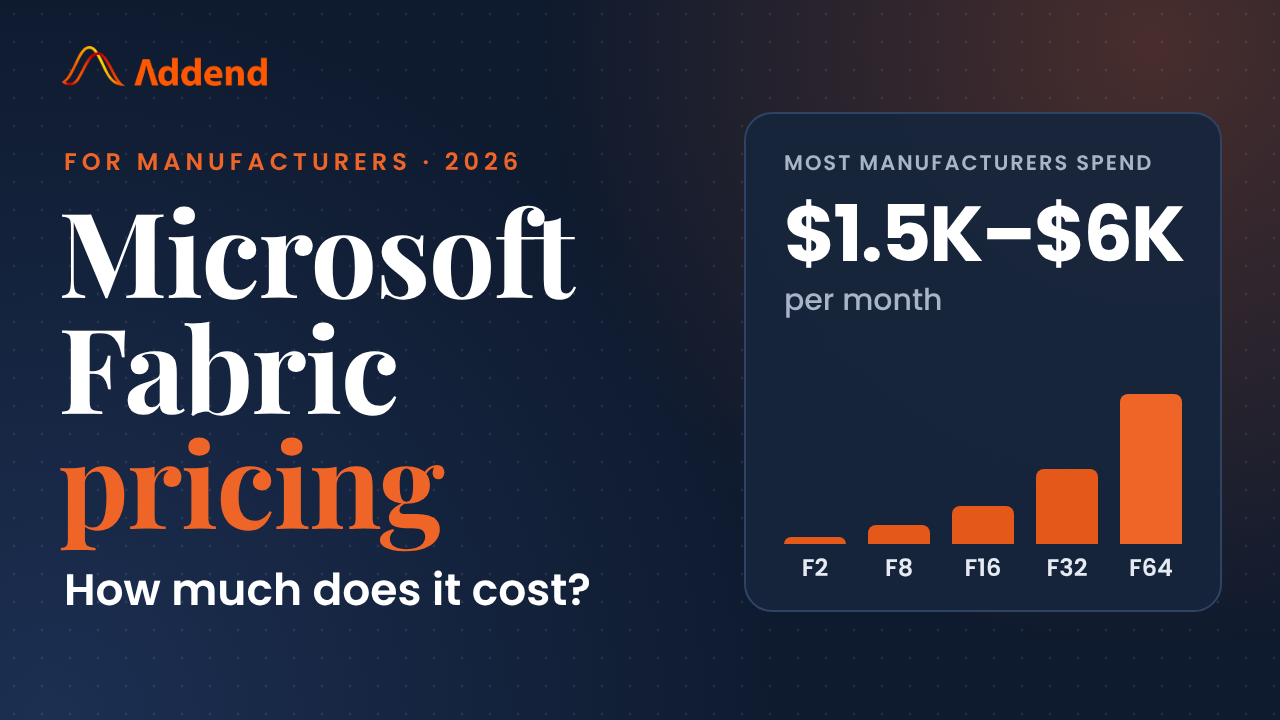
How we keep your microsoft fabric costs down
Pay for capacity, not per tool
We recommend the right capacity size in the readiness assessment.
The right license for each person
We map who needs which licence, so you don't overbuy.
Try Fabric before you commit
We run your proof of concept on the trial, so the decision is based on results.
Fewer tools, one copy of data
We build the business case and show what Fabric would cost to run before you sign up.
How Microsoft Fabric works
Microsoft Fabric is Microsoft's all-in-one analytics platform. Data integration, engineering, warehousing, data science, real-time analytics and Power BI all work on one shared copy of your data in OneLake, under one bill. Our services below cover each part.
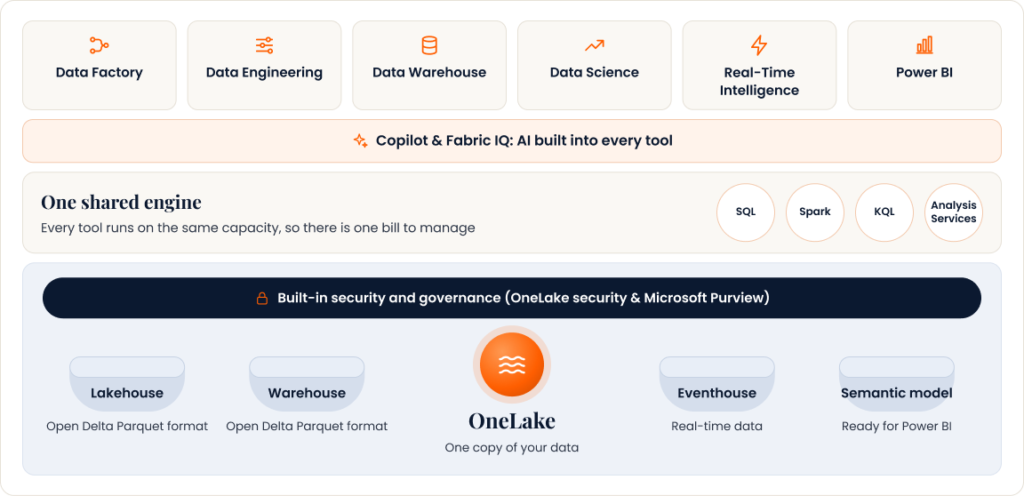
Every Fabric workload (Data Factory, Data Engineering, Data Warehouse, Data Science, Real-Time Intelligence and Power BI) reads and writes the same data in OneLake, secured with OneLake security and Microsoft Purview.
Our Microsoft Fabric services, for the enterprises in Arizona
Choose a service to see what's included. Start with one, or let us handle your full Microsoft Fabric implementation end to end.
Fabric Strategy & Roadmap
Readiness assessmentFind out where Fabric will pay off first. We review your current data and reporting, agree priorities with your leadership team and give you a clear plan and running-cost estimate.
Secure Fabric Setup & Governance
Security & cost controlA well-organised Fabric environment with the right access controls and cost monitoring, so your data stays protected and your spend stays predictable.
Data Warehouse & Lakehouse
Single source of truthBring data from finance, sales and operations into one trusted place, so every department reports the same numbers.
Data Integration & Engineering
Automated data flowsConnect your business systems and refresh data automatically, so teams stop copying spreadsheets and act on current information.
Power BI Reports & Dashboards
Decision-ready reportingClear, fast dashboards that leaders actually use, built on Fabric so every report draws on the same reliable data.
Real-Time Analytics
Live operational insightSee what is happening across your operations as it happens, with alerts when something needs attention.
Data Science & Predictive Analytics
Forecasting & predictionForecast demand, spot risks early and predict outcomes with machine learning built directly on your Fabric data.
Copilot & AI Readiness
AI you can trustPrepare your data so Copilot and AI assistants give accurate answers your teams can rely on.
BI Platform Modernisation
Legacy reporting upgradeReplace ageing reporting tools with modern Power BI and Fabric, cutting maintenance effort and giving people self-service access to data.
Microsoft Fabric migration services
Our Microsoft Fabric migration services move your data, pipelines and reports into Fabric without disrupting the business. Every migration starts with a short assessment, so you know the scope, timeline and cost upfront.
Power BI Premium to Fabric migration
Microsoft is moving Power BI Premium customers to Fabric. We handle the switch so your reports keep running and your teams gain the rest of Fabric.
Azure Synapse to Fabric migration
Bring your existing Azure data platform onto one simpler platform, with fewer services to manage and pay for.
SQL Server to Fabric migration
Move ageing on-premises SQL Server data and reporting to the cloud, without disrupting the reports your teams rely on.
AWS, Google Cloud & on-premises to Fabric
Consolidate data spread across other clouds and your own servers into one secure, central place.
How to get started with Microsoft Fabric in 3 steps
Our Microsoft Fabric implementation process
Step 1

We build a small pilot on your own data, so you see the value before committing to a full rollout.
Step 3

Case studies: results from our Microsoft data projects
Power BI on the Shop Floor: +20% Throughput
CUSTOMER STORY · FOOD PROCESSING MANUFACTURING From Manual Excel Reporting to Real-time Production Intelligence. Addend helped a leading American food manufacturer replace slow, static spreadsheet reporting with a governed, high-performance Power
Turning Inventory Data into Business Growth
CUSTOMER STORY · DATA ANALYTICS & BI Real-time Power BI Inventory InsightThat Cut Carrying Cost By 80% Addend helped a leading North American manufacturer replace slow, static spreadsheet reporting with
Case Study on Business Central integration
Case Study on Business Central integration D365 BC Integration App Client: Enliven Software LLC (Fidesic) Technology Solutions: D365 BC, Azure DevOps. Data Sources: REST APIs, Client App, D365 BC (Azure
Why choose Addend as your Microsoft Fabric partner
Data & AI
Microsoft Solutions Partner
Recognized by Microsoft for proven skills and delivery in data and AI.
5.0/5
Rated on G2
Independent client reviews on G2 rate Addend 5.0 out of 5.
500+
Projects in 8+ years
Microsoft analytics projects delivered for mid-market and enterprise organizations.
Power BI
Reporting depth
Power BI is where we started, with over 35 Power BI and data apps on Microsoft Marketplace, so the reports your teams use today keep working when you move to Fabric.
PoC first
Prove it before you commit
Start with one use case live on Fabric. Expand only when the results are clear.ISO 9001
Quality-managed delivery
ISO 9001:2015-certified delivery across 3 global offices, with documentation and handover on every project.
Microsoft Fabric consulting FAQs
Addend Analytics provides Microsoft Fabric consulting services to businesses across Arizona, including Phoenix, Scottsdale, Tempe, Chandler and Tucson. Addend Analytics is a Microsoft Solutions Partner for Data & AI, and its Fabric work covers readiness assessments, migration to OneLake and Power BI reporting.
Phoenix-area manufacturers use Microsoft Fabric to connect ERP, production, quality and supplier data in one platform. Maricopa County has 2,977 manufacturing businesses, the fifth most of any US county, according to the US Census Bureau’s County Business Patterns 2023. Power BI reports built on Fabric give fast-growing manufacturers one reliable view of output, scrap and on-time delivery.
Arizona developers, builders and property managers use Microsoft Fabric to connect project cost, scheduling, leasing and accounting data. Power BI dashboards built on Fabric track budget against actuals on each project and occupancy across completed properties. One Fabric data model gives project managers, finance teams and investors the same numbers as the portfolio grows.
Arizona law firms, engineering firms and accounting firms use Microsoft Fabric to bring timekeeping, billing, project and accounting data into one platform. Power BI reports on Fabric show billable utilization, write-downs and profitability by client or matter. Partners in Phoenix and Tucson get an up-to-date view of firm performance without manual month-end spreadsheets.
Arizona growers, food producers and consumer brands use Microsoft Fabric to combine harvest, production, inventory and sales data, from Yuma farms to Phoenix distributors. Power BI dashboards built on Fabric show yield, stock and margins by crop, product and customer. A single Fabric data model replaces the separate spreadsheets used by operations, sales and finance.
Mirroring in Microsoft Fabric replicates data from databases such as Azure SQL Database, Snowflake and Azure Cosmos DB into OneLake in near real time. Mirroring removes the need to build and maintain separate data pipelines for those sources. Mirrored data in Fabric can be queried with SQL and used directly in Power BI reports.
Microsoft Fabric handles data governance through Microsoft Purview integration, sensitivity labels, lineage views and endorsement of trusted datasets. Fabric domains let organizations group workspaces by department or business unit and assign owners to each. Lineage in Fabric shows where every report’s data comes from, which makes audits and impact analysis faster.
Microsoft Fabric includes a Data Science experience with notebooks, experiment tracking through MLflow and model training on data stored in OneLake. Fabric data agents let business users ask questions about company data in plain English. Machine learning models built in Fabric can score data in pipelines and feed predictions straight into Power BI reports.
Microsoft Fabric suits mid-sized companies because it replaces several separate data tools with one platform and one bill. The smallest Fabric capacity, F2, costs about $263 per month on pay-as-you-go at Microsoft’s Central US list prices, and pay-as-you-go capacity can be paused when idle. Mid-sized companies can start small with one use case and scale Fabric capacity as reporting needs grow.
Companies move from Tableau or Qlik to Power BI on Microsoft Fabric by rebuilding dashboards rather than converting them, because no official one-click converter exists. The migration includes recreating data models, translating calculations into DAX, and checking every figure against the original reports. Running both tools side by side during the move lets users confirm the numbers before the old licenses are retired.
A Microsoft Fabric proof of concept builds one real business use case, such as a single dashboard or data pipeline, on a company’s own data. A Fabric proof of concept usually runs for a few weeks and shows performance, cost and user feedback before a full rollout. Addend Analytics runs Fabric proofs of concept as a fixed-price engagement. [Confirm pricing model.]
Microsoft offers a free 60-day Microsoft Fabric trial for testing Fabric features. A Microsoft Fabric proof of concept with Addend Analytics builds one real business use case on a company’s own data, so results can be measured before a full rollout.