
A vector database stores data as high-dimensional vectors – mathematical representations of meaning -and retrieves it by similarity rather than exact matches. If you’ve built a recommendation engine, a chatbot, or a semantic search feature and found that a traditional database can’t keep up, a vector database is likely the missing piece. This guide explains how vector databases work, walks through working code, and shows where they fit in AI and machine learning pipelines.
What Is a Vector Database?
A vector database is a data store optimized to index, store, and query vector embeddings – numerical arrays that capture the semantic properties of text, images, audio, or other unstructured data.
Unlike a traditional database that matches rows on exact values (a customer ID, a date range), a vector database answers questions like “find the ten items most similar to this one.” That capability underpins semantic search, retrieval-augmented generation (RAG), recommendation systems, and anomaly detection.
How Do Vector Databases Work?
The workflow has four stages:
- Generate embeddings. A machine learning model (for example, an embedding model from OpenAI, Cohere, or an open-source sentence transformer) converts raw data into vectors, typically 384 to 1,536 dimensions.
- Index the vectors. The database builds a specialized index, such as HNSW (Hierarchical Navigable Small World) or IVF (Inverted File Index), so it doesn’t compare a query against every stored vector.
- Query by similarity. The application submits a query vector, and the database returns the nearest neighbors using a distance metric—cosine similarity, dot product, or Euclidean distance.
- Filter and rank results. Metadata filters (date, category, permissions) narrow the candidate set, and results are ranked by relevance score.
Most systems use approximate nearest neighbor (ANN) algorithms that trade a small amount of recall for large gains in speed.
A Minimal Example: Embeddings and Similarity
Before reaching for a database, it helps to see what similarity search actually computes. Cosine similarity measures the angle between two vectors:
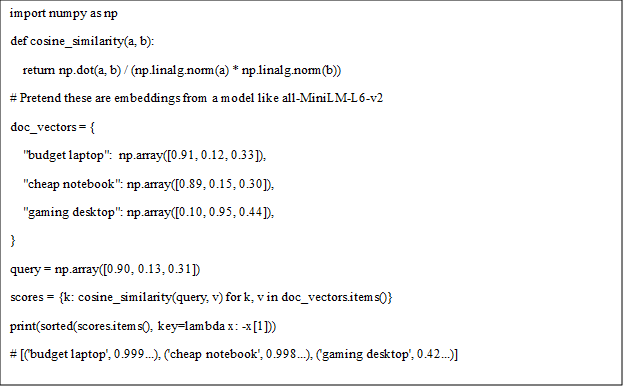
Note how “budget laptop” and “cheap notebook” rank high despite sharing no keywords -that’s semantic search. A vector database does this across millions of vectors in milliseconds.
Vector Database vs Traditional Database
| Capability | Traditional Database | Vector Database |
| Data type | Structured rows and columns | High-dimensional vectors + metadata |
| Query type | Exact match, range, joins | Similarity / nearest neighbor |
| Best for | Transactions, reporting | Semantic search, AI retrieval |
| Indexing | B-tree, hash | HNSW, IVF, PQ |
The two are complementary. Production AI systems often keep transactional data in PostgreSQL or MongoDB and store embeddings in a vector database, linking records by ID.
Hands-On: Semantic Search with Chroma
Chroma is an open-source vector database that runs locally, making it ideal for prototyping. Install it with pip install chromadb sentence-transformers.
The query “Can I get my money back?” shares no words with the stored document, yet the refund policy ranks first.
Practical Use Case: RAG for a Support Chatbot
A SaaS company wants its chatbot to answer questions from internal documentation.
- Split help articles into chunks of roughly 500 tokens.
- Embed each chunk and store it with metadata (product area, last updated).
- Embed the user’s question and run a vector search for the top five chunks.
- Pass those chunks as context to an LLM to generate a grounded answer.
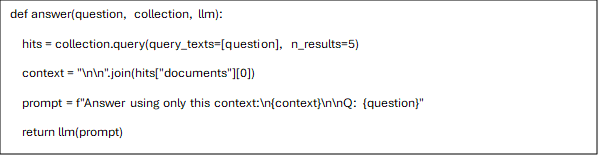
Without the vector database, the LLM would hallucinate or require fine-tuning every time documentation changed.
Choosing the Best Vector Database for AI Applications
Evaluate candidates on these criteria:
- Scale and latency: Can it handle your vector count and p95 latency target?
- Hybrid search: Does it combine vector similarity with keyword (BM25) search?
- Filtering: Are metadata filters efficient, or do they degrade recall?
- Deployment: Managed cloud, self-hosted, or embedded in an existing database?
- Ecosystem: SDKs, LangChain/LlamaIndex integrations, and backup tooling.
Common options include Pinecone, Weaviate, Qdrant, Milvus, pgvector (a PostgreSQL extension), and cloud services like Amazon OpenSearch Serverless and Azure AI Search. Capabilities and pricing change frequently—verify current documentation before deciding.
Frequently Asked Questions
What is a vector database in simple terms?
It’s a database that stores data as numerical vectors and finds items most similar to a query, rather than matching exact values.
How is a vector database different from a traditional database?
Traditional databases match exact or ranged values in structured rows. Vector databases index high-dimensional embeddings and retrieve nearest neighbors by similarity.
Do I need a vector database for AI?
Only if you need fast similarity search over embeddings. Small prototypes can use in-memory libraries like FAISS, but production systems usually need persistence, filtering, and concurrency.
What are vector embeddings?
Dense numerical arrays produced by machine learning models that encode the meaning of data so similar items sit close together in vector space.
Can I use PostgreSQL instead of a dedicated vector database?
Yes. Extensions like pgvector add vector search to PostgreSQL, which works well at moderate scale. Dedicated vector databases typically offer higher throughput and more advanced ANN tuning at very large scale.
Conclusion
A vector database turns embeddings into fast, scalable similarity search—the foundation of semantic search, recommendations, and RAG pipelines. Start with a local tool like Chroma to validate the approach, then scale to a managed or self-hosted system once you know your latency, filtering, and volume requirements. The right choice depends less on hype and more on how your AI application retrieves knowledge.
Author By

Afroz Labbai
Afroz is a Data Engineer and Team Lead with 4+ years of experience in building scalable data platforms using Azure technologies such as Azure Data Factory, Azure SQL, Databricks, and Synapse. He specialises in ETL development, SQL optimisation, and data modelling, delivering reliable and cost-efficient solutions for enterprise analytics. He is passionate about continuous learning, mentoring teams, and driving data-driven decision-making.