
Introduction
Modern organizations generate massive amounts of data from multiple sources such as ERP systems, cloud applications, IoT devices, customer platforms, and operational databases. Managing this data across different tools and platforms often creates challenges related to integration, scalability, governance, and performance.
Traditionally, organizations relied on separate tools for data engineering, data warehousing, analytics, and reporting. This fragmented approach increased complexity and operational costs.
Microsoft Fabric addresses these challenges by providing a unified analytics platform that combines data integration, engineering, storage, science, real-time analytics, and business intelligence into a single ecosystem.
With Microsoft Fabric, organizations can build complete end-to-end analytics solutions efficiently, enabling faster insights and better decision-making.
What is End-to-End Analytics in Microsoft Fabric?
End-to-End Analytics refers to the complete lifecycle of data processing—from data ingestion to visualization and decision-making—within a single integrated platform.
Microsoft Fabric brings together multiple services including:
- Data Engineering
- Data Factory
- Data Warehouse
- Data Science
- Real-Time Analytics
- Power BI
This integration eliminates the need for switching between multiple tools and simplifies the analytics workflow.
How End-to-End Analytics Works in Microsoft Fabric
The analytics workflow in Microsoft Fabric follows a connected and centralized architecture.
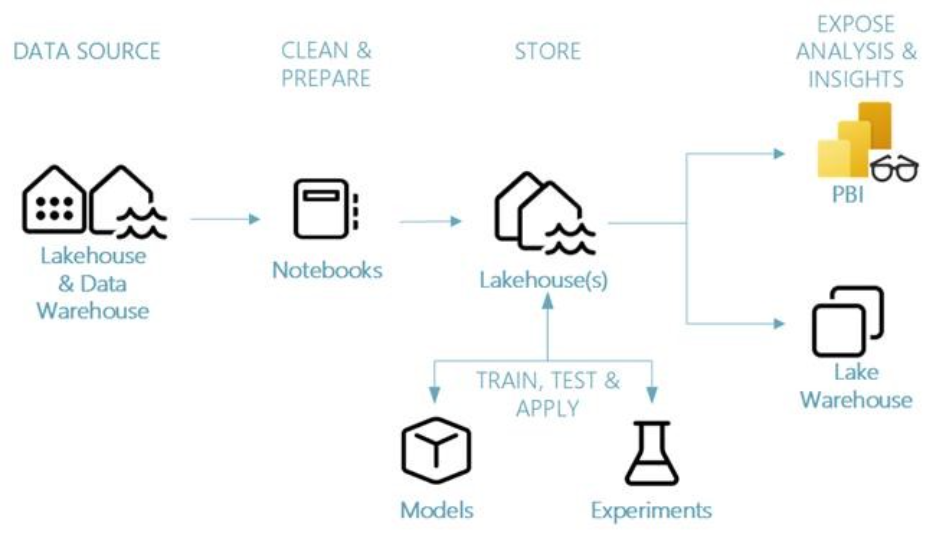
Workflow Process
- Data Ingestion
Data is collected from databases, APIs, cloud platforms, ERP systems, and streaming sources.
- Data Engineering & Transformation
Data pipelines clean, transform, and prepare the data for analytics.
- Centralized Storage with OneLake
Processed data is stored in OneLake, Microsoft Fabric’s unified storage layer.
- Data Warehousing & Analytics
Data warehouses and Lakehouses are used for analytical processing and querying.
- Data Science & Machine Learning
AI and machine learning models generate predictions and insights.
- Visualization with Power BI
Interactive dashboards and reports are created for business users.
This creates a fully integrated analytics ecosystem.
Real-World Use Case
Consider a retail company managing sales operations across multiple regions.
The organization receives data from:
- ERP systems
- E-commerce platforms
- Customer applications
- Inventory databases
Without a unified platform:
- Data exists in silos
- Multiple tools are required for processing and reporting
- Reporting delays occur
Using Microsoft Fabric:
- Data is ingested into OneLake
- Data pipelines transform and clean information
- Real-time analytics track inventory and sales
- Power BI dashboards provide instant business insights
- AI models predict customer demand and sales trends
This enables faster decision-making and operational efficiency.
Key Components of Microsoft Fabric
1. OneLake
A centralized storage layer that acts as a single source of truth for organizational data.
2. Data Factory
Used for data ingestion and pipeline orchestration.
3. Lakehouse
Combines the flexibility of data lakes with the performance of data warehouses.
4. Data Warehouse
Supports enterprise-level SQL analytics and reporting.
5. Real-Time Analytics
Processes streaming and live data efficiently.
6. Power BI Integration
Provides interactive reporting and visualization capabilities directly within Fabric.
Benefits of End-to-End Analytics in Microsoft Fabric
- Unified analytics platform
- Reduced complexity and tool dependency
- Faster data integration and reporting
- Improved scalability for enterprise workloads
- Centralized governance and security
- Real-time and AI-powered analytics capabilities
- Seamless Power BI integration
- Better collaboration across teams
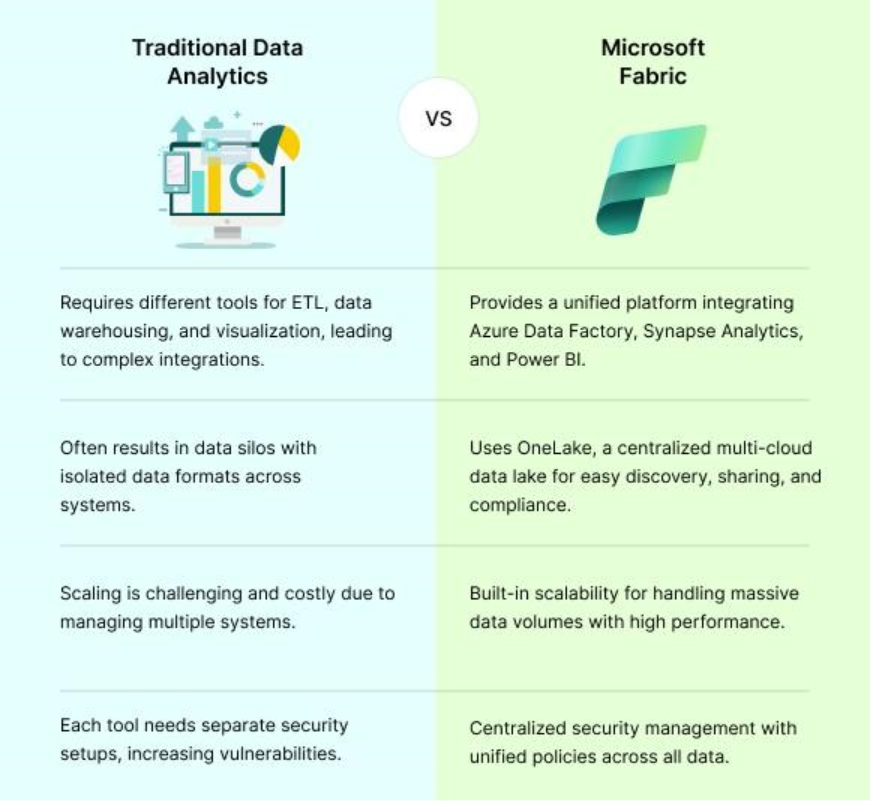
Microsoft Fabric vs Traditional Analytics Architecture
Key Considerations
- Proper governance and security configurations are essential
- Teams may require training on Fabric services
- Data architecture planning is important for scalability
- Premium licensing may be required for enterprise workloads
Conclusion
Microsoft Fabric is transforming modern analytics by providing a unified platform for end-to-end data processing, analytics, AI, and visualization. By integrating multiple services into a single ecosystem, Fabric reduces complexity, improves collaboration, and accelerates business insights.
As organizations continue moving toward cloud-based and AI-driven analytics solutions, Microsoft Fabric is becoming a key platform for building scalable and future-ready analytics architectures.
For data professionals and enterprises, mastering end-to-end analytics in Microsoft Fabric is a crucial step toward modernizing data operations and achieving faster, smarter, and more efficient decision-making.
Author By

Afroz Labbai
Afroz is a Data Engineer and Team Lead with 4+ years of experience in building scalable data platforms using Azure technologies such as Azure Data Factory, Azure SQL, Databricks, and Synapse. He specialises in ETL development, SQL optimisation, and data modelling, delivering reliable and cost-efficient solutions for enterprise analytics. He is passionate about continuous learning, mentoring teams, and driving data-driven decision-making.