
When dealing with large-scale ETL (Extract, Transform, Load) workloads, stored procedures often become the bottleneck. As data volumes grow, inefficient stored procedures can lead to extended processing times, resource exhaustion, and failed pipeline executions. This guide covers practical optimization strategies for SQL Server stored procedures that power enterprise ETL processes.
Understanding the Performance Bottleneck
In large-scale ETL workflows, stored procedures handle everything from data validation and transformation to incremental loading and history tracking. The challenge is that traditional interpreted stored procedures are compiled at first execution, and their performance degrades as data volumes scale. Additionally, poorly optimized extraction queries lead to increased execution time and unnecessary load on database servers, impacting the entire pipeline.
Key Optimization Strategies
1. Leverage Natively Compiled Stored Procedures
One of the most powerful yet underutilized features in SQL Server is natively compiled stored procedures through In-Memory OLTP. Unlike interpreted stored procedures that compile at first execution, natively compiled procedures are compiled when created, generating efficient native code that executes directly.

Performance gains: Natively compiled stored procedures can process millions of rows with significantly lower latency compared to interpreted T-SQL, making them ideal for high-throughput ETL operations.
2. Optimize Query Processing and Statistics
For memory-optimized tables accessed by stored procedures, query optimization works differently than with disk-based tables. The optimizer relies heavily on statistics for cost estimations. Update statistics after loading data and before creating natively compiled procedures:
3. Use Set-Based Operations Over Row-by-Row Processing
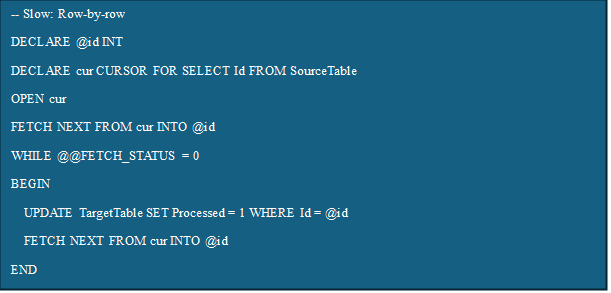
Row-based operations within stored procedures are a common performance killer. Replacing cursors and WHILE loops with set-based operations significantly reduces processing overhead. Instead of:
Use:
4. Implement Chunking for Large Datasets
When processing extremely large tables, chunking—breaking the workload into smaller, manageable batches—can prevent transaction log bloat and improve performance. A common pattern uses stored procedures that accept a chunk parameter:
This approach ensures queries complete reliably and allows parallel execution across multiple chunks.
5. Optimize Lookup Transformations
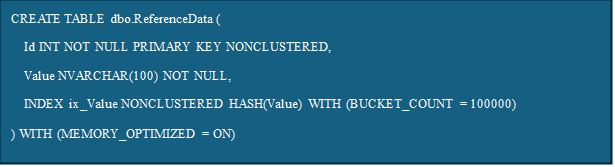
Lookup operations in stored procedures often become bottlenecks. Instead of querying reference tables for each row, pre-load reference data into memory-optimized tables or use cache mode for lookups. For memory-optimized tables, consider using HASH indexes for equality lookups to achieve O(1) performance:
6. Indexing Strategy for Stored Procedures
Proper indexing is critical. For analytical workloads in ETL scenarios, columnstore indexes have changed the performance profile of large-scale reporting queries by compressing data and reading only the columns a query actually touches. For high-volume insert/update operations, consider:
- Dropping non-clustered indexes before bulk operations and rebuilding afterward
- Using table partitioning to split large fact tables across filegroups for faster loads and manageable maintenance
- Using HASH indexes for memory-optimized tables with equality-based lookups
7. Minimize Logging Overhead
When loading large datasets within stored procedures, use:
- Bulk insert operations with TABLOCK hint to minimize logging
- Minimal logging by using ALTER DATABASE … SET RECOVERY SIMPLE during bulk loads (temporarily)
- Batch size optimization for transaction management
8. SSIS Integration Considerations
If your stored procedures are called from SSIS packages, note that when invoking natively compiled stored procedures from SSIS, using ODBC Source/Destination without the EXEC keyword provides better performance and avoids cursor-based execution issues
Monitoring and Troubleshooting
Use SQL Server Performance Counters and SQL Profiler to measure optimization impact. Key metrics to monitor:
- CPU utilization
- Memory pressure
- Disk I/O operations
- Query execution time
For memory-optimized tables, ensure proper bucket counts for hash indexes—incorrect configuration can lead to performance degradation.
Conclusion
Optimizing stored procedures for large-scale ETL requires a multi-faceted approach: leveraging natively compiled procedures where appropriate, using set-based operations, implementing chunking for massive datasets, and maintaining proper indexing strategies. By applying these techniques, organizations can significantly reduce ETL processing time and build scalable data pipelines that handle growing data volumes efficiently.
Author By

Gaurav Lakhotia
Gaurav holds an MBA in Business Analytics. As a data geek and avid learner, he has earned accolades including Microsoft Certified Data Analyst, Microsoft Certified Azure Administrator, and active Power BI Community contributor. He is also a Microsoft Certified Trainer. With critical thinking and project delivery skills, he strives to achieve customer delight in Data Analytics projects. Gaurav loves travelling with friends when he is not busy working on data.