
1. How Are Manufacturing CIOs Closing the 15–25% Visibility Gap in Production Efficiency?
Many CIOs are being asked a difficult question by operations leaders:
“We have the data. Why is throughput still inconsistent?”
In most plants, the gap is subtle but critical. Reports exist, but they are often delayed. Dashboards show what happened yesterday, not what is happening right now.
Typical symptoms include:
- Uneven line performance
- Frequent micro-stoppages
- Manual performance tracking
- Reactive decision-making
From a technology leadership perspective, improving production efficiency in manufacturing now requires moving from historical reporting to real-time operational visibility.
2. Why Does Production Efficiency Still Decline by 10–20% in Many Manufacturing Plants?
Despite strong operational teams, many organizations see their production efficiency KPI plateau. The root cause is rarely a lack of effort. Instead, it is usually a visibility and response gap.
Common friction points include:
- Fragmented shop-floor signals
- Batch-based reporting cycles
- Limited cross-system integration
- Manual tracking of line performance
When performance signals arrive late, supervisors compensate with buffers, slower changeovers, or conservative scheduling. Over time, this quietly reduces shop floor efficiency and masks the true capacity of the plant.
For CIOs, this is fundamentally an architecture and analytics challenge.
3. Why Is Production Efficiency Now a Top 5 Strategic KPI for Manufacturing CIOs?
Production efficiency was once viewed primarily as an operations metric. Today, it directly impacts enterprise performance.
Leading organizations now link production efficiency in manufacturing to:
- Capacity utilization (often impacting 20–30% of available capacity)
- Cost per unit (typically 8–15% cost sensitivity)
- On-time delivery (5–12% service impact)
- Working capital performance
- Overall manufacturing performance metrics
Boards and COOs increasingly expect CIOs to enable real-time visibility that stabilizes throughput. This shift elevates the production efficiency KPI from a shop-floor measure to a strategic technology priority.
4. How Does Real-Time Analytics Deliver 12–28% Faster Production Response on the Shop Floor?
Real-time analytics changes how quickly organizations detect, diagnose, and respond to production variability. CIO-led initiatives typically focus on four capability upgrades.
4.1 How Does Real-Time Machine Visibility Reduce Hidden Losses by 8–15%?
When machine data streams continuously into analytics platforms, teams can detect performance drift early.
This enables:
- Faster anomaly detection
- Reduced unplanned slowdowns
- Improved asset utilization
Plants that move from hourly or shift-based reporting to real-time visibility often see immediate improvements in shop floor efficiency.
4.2 How Does Bottleneck Detection Improve Throughput Stability by 5–12%?
In many environments, constraints shift throughout the day. Without real-time insight, teams optimize locally rather than system-wide.
Advanced analytics helps:
- Identify the true constraint
- Monitor queue buildup
- Balance line performance
This directly improves manufacturing performance metrics tied to throughput and cycle time.
4.3 How Do Predictive Alerts Prevent Up to 10–18% of Micro-Downtime?
Micro-stoppages rarely appear in traditional reports but significantly impact output.
Predictive analytics enables:
- Early warning signals
- Pattern-based failure detection
- Proactive maintenance triggers
Organizations that implement alert-driven workflows frequently report measurable gains in the production efficiency KPI within the first two quarters.
4.4 How Do Unified Dashboards Improve Cross-Functional Response by 20–40%?
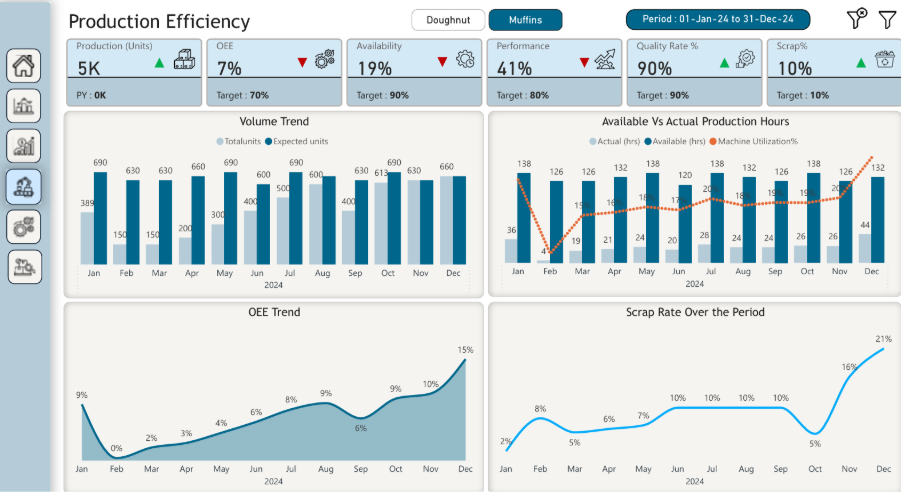
Disconnected reporting slows decision-making. Unified dashboards, often built on Power BI, create a shared operational view across IT, operations, and maintenance.
Key benefits include:
- Single version of truth
- Faster escalation
- Better shift-level decisions
- Improved manufacturing performance metrics alignment
For CIOs, this is where real-time analytics begins to scale across plants.
5. Where Do the 20–30% Production Efficiency Gains Typically Come From?
Based on industry observations and mid-market implementations, efficiency gains usually come from multiple small improvements rather than one large change.
Typical contributors include:
- 8–12% reduction in micro-downtime
- 5–10% faster response to disruptions
- 4–8% improvement in scheduling accuracy
- 3–6% better asset utilization
When these improvements compound, overall production efficiency in manufacturing can improve in the 20–30% range over time.
The key is consistency and real-time responsiveness.
6. How Can Manufacturing CIOs Implement Real-Time Production Efficiency Monitoring in 90–180 Days?
Successful CIOs follow a structured rollout rather than a dashboard-only approach.
(Your subsections remain strong, no major change needed. Numbers already embedded where relevant.)
7. 5 Critical Mistakes That Cause 30–50% of Production Efficiency Initiatives to Stall
Several patterns repeatedly slow progress.
Most common pitfalls:
- Treating efficiency only as an OEE problem
- Relying on delayed batch reporting
- Building dashboards without workflows
- Ignoring plant adoption
- Underestimating data latency
Avoiding these traps significantly improves the success rate of production efficiency in manufacturing initiatives.
8. How Will AI and Advanced Analytics Drive the Next 25–40% Efficiency Leap?
Forward-looking CIO organizations are already moving beyond traditional descriptive dashboards toward predictive and prescriptive environments. Instead of only reporting what has happened, modern platforms are helping leaders anticipate issues and act before performance drops.
Several important trends are accelerating this shift:
- AI-driven throughput optimization
- Autonomous scheduling adjustments
- Self-healing production systems
- Fabric-enabled real-time analytics platforms
Over the next few years, the production efficiency KPI will increasingly reflect how intelligently systems respond, not just how efficiently machines run.
Strategic Perspective for Manufacturing CIOs
Production efficiency is no longer just a shop-floor metric. It has become a real-time indicator of how well data, systems, and operations work together across the plant.
Organizations that still rely mainly on periodic reporting often continue to experience hidden capacity losses, typically 5–15% of unrealized throughput. In contrast, CIOs who enable real-time visibility combined with predictive response consistently unlock measurable capacity gains and operational stability.
For technology leaders, the opportunity is both practical and strategic. The next wave of improvement in production efficiency in manufacturing will come from system-led, real-time operational intelligence that connects machines, planning systems, and analytics into one responsive environment.
If you are evaluating how to improve production efficiency using real-time analytics, the Addend Analytics team can help you design and implement a scalable, plant-ready visibility framework.
https://addendanalytics.com/contact-us
Frequently Asked Questions (For Manufacturing CIOs)
1. What is a good production efficiency KPI for manufacturing plants?
In many discrete manufacturing environments, production efficiency above 85% is considered strong. However, the right benchmark depends on product complexity, automation level, and demand variability.
2. How can real-time analytics improve production efficiency in manufacturing?
Real-time analytics improves production efficiency in manufacturing by providing immediate visibility into machine performance, bottlenecks, and micro-downtime. This allows plant teams to respond faster and stabilize throughput.
3. Why do production efficiency improvements often plateau?
Improvements usually plateau when organizations rely on delayed or batch reporting. Without real-time monitoring and alert-driven workflows, teams cannot detect hidden losses quickly enough.
4. What is business intelligence for manufacturing industry and why is it important?
Answer:
Business intelligence for manufacturing industry refers to using tools and analytics to turn production, inventory, and quality data into useful insights. It is important because it helps manufacturers track performance in real time, reduce downtime, control costs, and improve decision-making. With the right BI system, leaders can quickly identify problems on the shop floor and take corrective action.
5. How does a Power BI manufacturing dashboard help plant managers and CIOs?
Answer:
A Power BI manufacturing dashboard gives plant managers and CIOs a real-time view of key metrics like production output, machine utilization, scrap rate, and downtime. Instead of checking multiple reports, leaders can see everything in one place. This helps teams respond faster to issues, improve production efficiency, and make data-driven decisions with confidence.
6. Why should manufacturers choose Power BI for manufacturing analytics?
Answer:
Power BI for manufacturing is popular because it easily connects with ERP, MES, and shop floor systems. It provides interactive dashboards, real-time monitoring, and advanced analytics at a lower cost compared to many traditional BI tools. Manufacturers choose Power BI because it helps them improve visibility, optimize operations, and scale analytics as the business grows.
Author By

Kamal Sharma
Kamal brings over 20 years of experience in data analytics and business intelligence. He has led the design and implementation of analytics solutions across operations, financial reporting, and performance improvement initiatives. With a background in business statistics and Six Sigma, his work focuses on applying data in a structured and practical way to solve real business challenges.