
Executives are being asked a new kind of question from their analytics investments.
Not “Do we have visibility?”
But “Can we make better decisions faster, with less risk?”
This shift explains why generative analytics has moved from an experimental concept to a boardroom topic in a short period of time. It is not because dashboards stopped working. It is because the limits of traditional business intelligence have become visible in environments where speed, accountability, and uncertainty now define competitive advantage.
According to McKinsey, more than 70% of organizations use AI in at least one business function, yet fewer than one-third report a material impact on decisions or performance at scale. The gap is not adoption. It is an application.
Generative analytics emerges at precisely this intersection, where leaders are no longer satisfied with reporting outcomes and expect analytics to participate in decision-making itself.
What Generative Analytics Actually Means (In Practical Terms)
Generative analytics is often described loosely, which creates confusion.
In operational terms, generative analytics refers to analytics systems that generate explanations, scenarios, and recommendations dynamically, using enterprise data combined with large language models and reasoning capabilities.
Unlike BI, which retrieves and visualizes predefined metrics, generative analytics:
- Interprets data across domains
- Explains drivers and trade-offs
- Simulates scenarios
- Produces decision-oriented narratives in natural language
The output is not a chart by default.
It is an analysis expressed as reasoning.
This distinction matters because it changes how analytics is consumed, moving from review to dialogue, and from inspection to action.
Why Traditional BI Works and Where It Stops
Business intelligence platforms were built for consistency, repeatability, and auditability. They are excellent at answering questions such as:
- What happened?
- How did performance compare to targets?
- Where did results vary?
Dashboards and reports remain essential for governance, finance, and operational oversight.
However, BI assumes that:
- The question is already known
- The metric definition is agreed
- Interpretation is a human responsibility
As organizations scale and complexity increases, these assumptions break down. Decision-makers increasingly need help understanding why patterns are occurring, what might happen next, and what options exist under uncertainty.
This is not a visualization problem.
It is a reasoning problem.
Generative Analytics vs Business Intelligence: The Real Difference
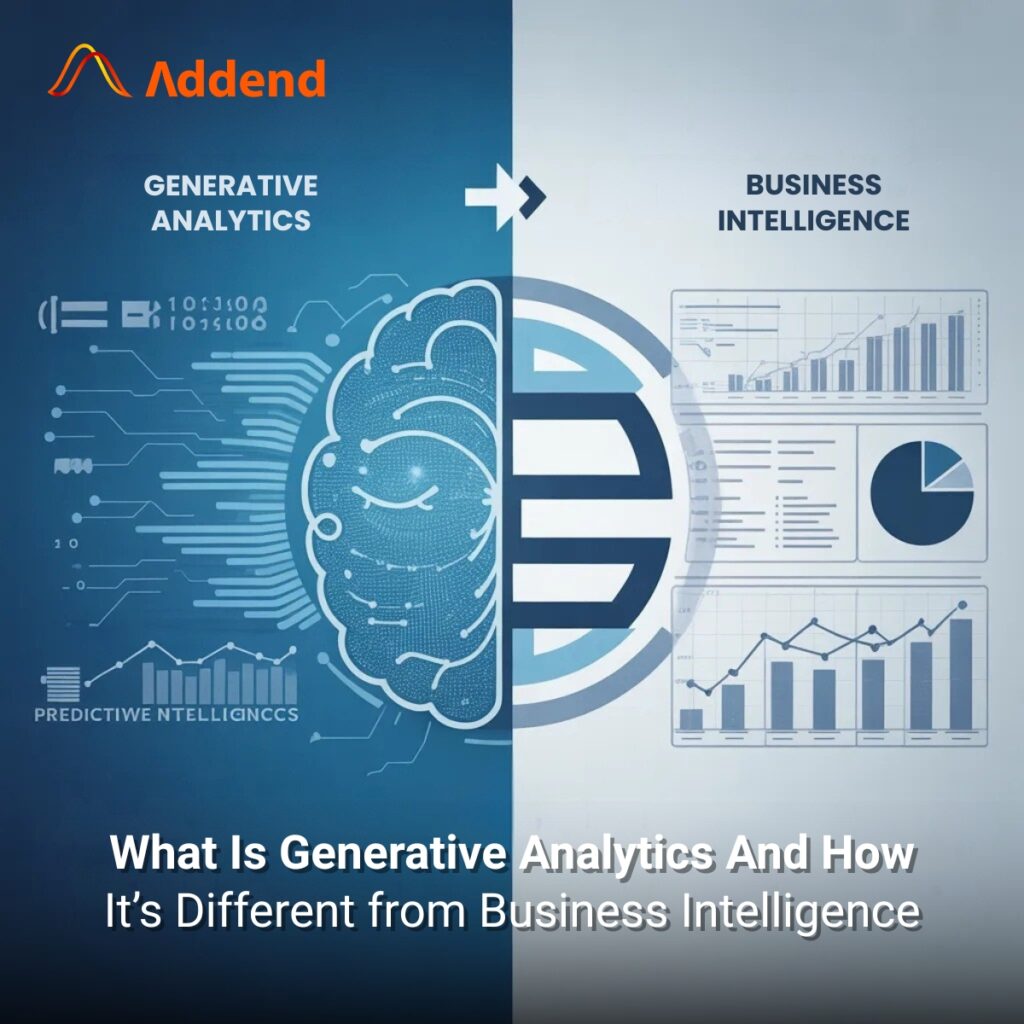
The difference between BI and generative analytics is not incremental; it is functional.
Business Intelligence
- Answers predefined questions
- Visualizes known metrics
- Relies on human interpretation
- Primarily descriptive and diagnostic
Generative Analytics
- Generates explanations and scenarios
- Synthesizes insights across domains
- Reasons in natural language
- Supports predictive and prescriptive decisions
In practice, BI tells you what changed.
Generative analytics helps you understand what it means and what to consider doing next.
This is why executives experience generative analytics as fundamentally different not because it looks different, but because it engages with decision-making itself.
Why Generative Analytics Is Emerging Now
The concept of generative analytics is not new. The feasibility is.
Three changes have converged:
- Mature large language models capable of reasoning over complex inputs
- Modern analytics platforms that unify data engineering, analytics, and AI
- Rising decision pressure in volatile, regulated, cost-sensitive environments
According to Gartner, a significant percentage of generative AI initiatives stall after proof-of-concept because organizations underestimate data readiness, governance, and decision alignment. This does not invalidate the capability; it highlights the conditions required for it to work.
Generative analytics succeeds when it is grounded in trusted analytics foundations, not when it is layered on top of fragmented reporting environments.
How does Generative Analytics Actually Work (At an Executive Level)
From an architecture perspective, generative analytics depends on four elements working together.
1. Governed Data Foundations
A single, trusted data foundation with consistent definitions and lineage is non-negotiable. Generative systems amplify inconsistencies rather than hide them.
2. Semantic Models and Business Context
Generative analytics relies on semantic layers that encode business meaning so explanations align with how the organization measures performance.
3. Reasoning and Language Models
Large language models interpret data contextually, generate explanations, and simulate scenarios, but only within the constraints provided.
4. Decision Interfaces
Outputs must surface where decisions are made: executive briefings, analytics tools, or conversational interfaces such as Microsoft Copilot.
Where Generative Analytics Creates Measurable Value
Organizations that deploy generative analytics effectively tend to focus on specific decision classes.
- Finance: Variance explanations, scenario analysis, and forward-looking risk commentary reduce reconciliation cycles and decision latency.
- Operations: Predictive signals combined with recommended actions improve response times in manufacturing and supply chains.
- Commercial: Scenario-based pricing and demand reasoning support faster, more defensible decisions.
- Legal & Compliance: Contract and risk analysis reduces review time while increasing coverage.
According to McKinsey, organizations with unified data and analytics foundations reduce analytics and AI rework by 30–40%, accelerating time-to-value and improving trust.
Why Generative Analytics Often Fails
Failure modes are consistent.
Research from MIT Sloan shows that analytics initiatives fail not because models are weak, but because:
- Data definitions are inconsistent
- Governance is reactive
- Decision ownership is unclear
- Outputs cannot be defended
Generative analytics magnifies these issues. Without discipline, it produces confident answers that leaders hesitate to trust.
This is why generative analytics acts as a stress test for analytics maturity.
A Practical Executive Checklist for Adopting Generative Analytics
Before scaling generative analytics, executives should confirm:
- The decision being augmented is clearly owned and high-value
- Data definitions are consistent and governed
- Outputs can be explained and defended
- Human oversight and accountability are defined
- The pilot can move to production without re-architecture
If any of these are unclear, the risk is not technical it is operational.
Addend Analytics’ Perspective
Addend Analytics approaches generative analytics as a decision capability, not a feature.
The focus is on:
- Decision design before model design
- Analytics foundations before generative layers
- Governance embedded into architecture
- Microsoft-native platforms such as Microsoft Fabric and Copilot for scalable execution
By aligning generative analytics with operational analytics and AI-ready data foundations, Addend helps organizations move beyond experimentation toward decision impact without increasing risk.
Request a Generative Analytics Readiness Assessment
Frequently Asked Questions (For Executives)
Is generative analytics replacing BI?
No. BI remains the authoritative source of metrics. Generative analytics interprets and extends BI into reasoning and scenarios.
How is this different from natural-language BI?
Natural-language BI retrieves data. Generative analytics reasons over it and proposes implications.
What data maturity is required?
At minimum: governed definitions, lineage, and production-grade pipelines.
Where does Microsoft Copilot fit?
Copilot provides the conversational interface; generative analytics provides the reasoning behind the answers.
Generative analytics represents a meaningful evolution in how analytics supports leadership decisions. It moves analytics from presentation to reasoning, and from insight delivery to insight generation.
Its value, however, is not automatic. When treated as a BI enhancement, it disappoints. When built on disciplined analytics foundations and aligned to real decisions, it becomes a force multiplier.
For CIOs and CFOs, the question is no longer whether generative analytics is coming but whether the organization is ready to trust it.
View Industry Examples and Analytics & AI Accelerators