
3 Key Realities About Executive Visibility in Modern Manufacturing
Across many mid-size US manufacturing organizations, executive visibility remains limited despite significant investments in ERP, MES, and connected manufacturing technologies. CIOs are responsible for managing complex enterprise architectures, integrating operational systems, and enabling data-driven decision-making.
However, even with modern technology stacks, leadership teams often struggle to access unified insights across systems. Data exists in multiple platforms, yet executive visibility remains fragmented.
Executives frequently ask questions such as:
- What is happening across plants right now?
- Where are system bottlenecks emerging?
- Which processes are creating operational risks?
- Where are cost deviations occurring across systems?
The challenge is not data availability.
The challenge is system-driven visibility and analytics architecture.
Many manufacturing organizations still rely on disconnected reporting layers, fragmented dashboards, and delayed analytics pipelines. These limitations prevent CIOs from delivering real-time executive intelligence.
Across mid-size manufacturing environments, three realities commonly appear.
1. Reporting Architecture Is Fragmented Across Systems
Manufacturing organizations typically operate multiple platforms including ERP, MES, data warehouses, and IoT environments. While each system captures valuable information, these platforms often operate independently.
CIOs must rely on manual data aggregation, custom queries, and batch-based reporting pipelines. This fragmented architecture creates latency in executive reporting and prevents leadership teams from accessing unified insights.
When reporting architecture is fragmented, CIOs face challenges such as delayed analytics delivery, inconsistent data models, and limited executive visibility.
2. Data Pipelines Are Delayed and Not Real-Time
Many organizations rely on scheduled data refresh cycles rather than real-time pipelines. Data is extracted, transformed, and loaded periodically, which creates delays in executive visibility.
Without real-time analytics pipelines, leadership teams operate on historical information rather than live operational intelligence. This reduces decision speed and limits proactive interventions.
Modern CIOs require streaming analytics, event-driven architecture, and near real-time data processing to enable executive visibility.
3. Disconnected Dashboards Limit Executive Intelligence
In many manufacturing organizations, dashboards are built independently across departments. ERP dashboards, operational dashboards, and financial dashboards operate separately.
This creates multiple versions of truth and fragmented executive insights. CIOs struggle to provide a unified control layer across systems.
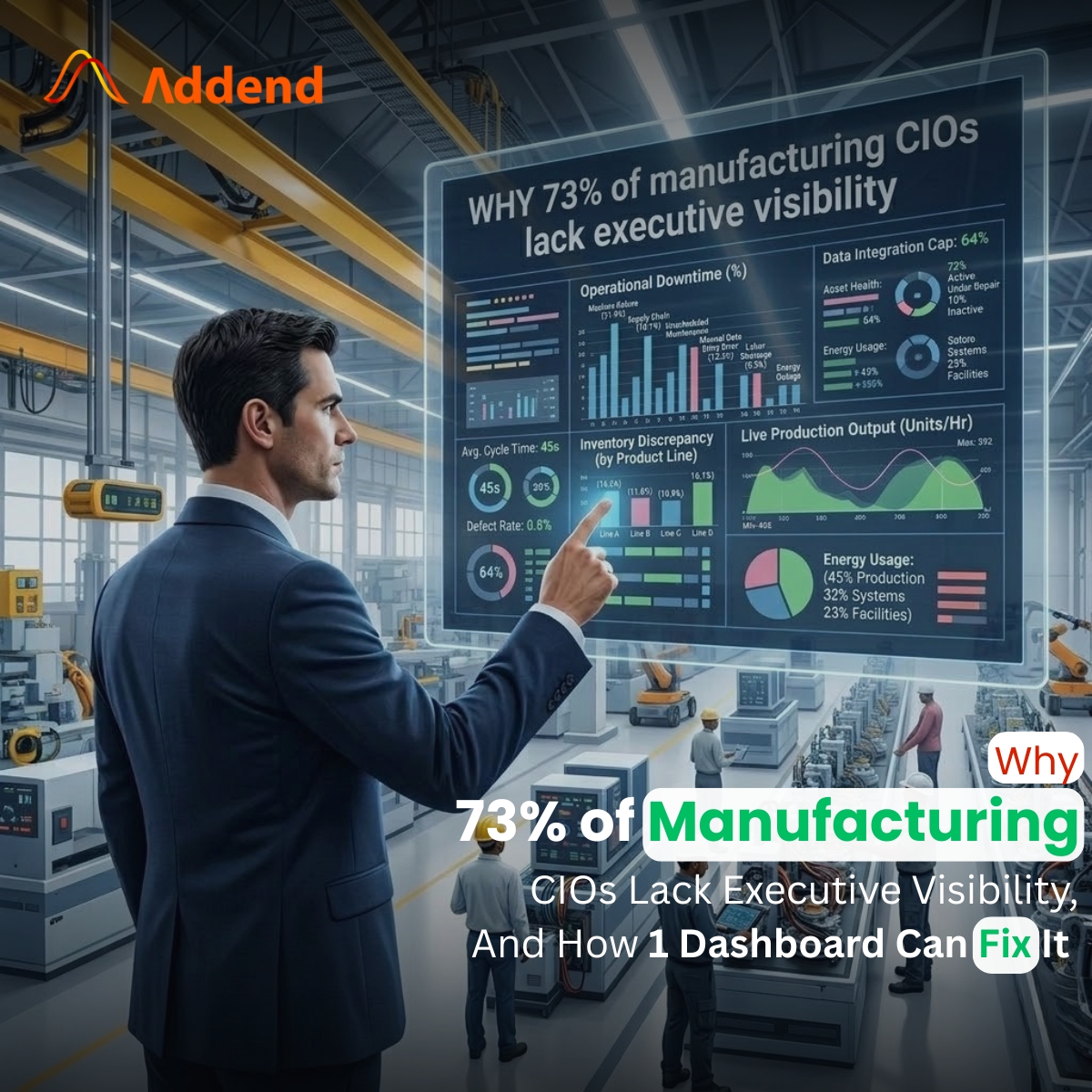
This is why 73% of Manufacturing CIOs lack executive visibility.
When system visibility is fragmented, executive intelligence becomes limited.
When executive intelligence is limited, decision latency increases.
This is where one unified executive dashboard changes everything.
Why Executive Visibility Remains Limited in Manufacturing Organizations
Manufacturing CIOs manage complex enterprise ecosystems that include ERP platforms, MES systems, IoT devices, quality systems, and supply chain platforms.
However, these systems often operate independently without a unified analytics layer.
Common causes of limited executive visibility include:
- Disconnected data architecture
- Batch-based reporting pipelines
- Inconsistent data models
- Multiple analytics tools
- Lack of centralized dashboards
These challenges create decision latency across leadership teams.
For example, when system alerts, cost signals, and operational indicators are not unified, executives cannot identify risks early. By the time insights reach leadership, the impact has already occurred.
Reducing this visibility gap is one of the most impactful responsibilities of modern manufacturing CIOs.
The Shift from Historical Reporting to Real-Time Executive Intelligence
Traditional manufacturing reporting relies on batch analytics and periodic reporting cycles. These approaches create delays in decision-making and reduce responsiveness.
Modern manufacturing environments require real-time executive intelligence supported by integrated analytics architecture.
Real-time executive dashboards enable:
- Live system intelligence
- Exception-based monitoring
- Cross-system visibility
- Predictive analytics insights
- Centralized executive reporting
Organizations adopting real-time analytics architecture often experience improved decision speed, reduced reporting latency, and better executive visibility.
The System Architecture Behind One Executive Dashboard
Improving executive visibility requires integrating multiple enterprise systems into a unified analytics architecture.
A typical architecture includes:
ERP Systems
ERP platforms provide financial, procurement, and inventory data. These systems form the core enterprise data layer for executive intelligence.
MES Systems
MES platforms capture operational data streams and process-level insights. This supports operational analytics and visibility.
Machine Data and IoT Signals
Connected machines generate real-time telemetry, alerts, and performance signals. These data streams enable advanced analytics and predictive insights.
Real-Time Data Pipelines
Modern data pipelines connect ERP, MES, and machine systems into unified analytics layers. Streaming pipelines enable near real-time visibility.
Executive Control Tower Dashboard
The executive dashboard provides:
- Cross-system intelligence
- Risk indicators
- Cost analytics
- System alerts
- Executive-level visibility
This unified architecture enables CIOs to deliver system-driven executive intelligence.
The Measurable Benefits of Executive Dashboards
Organizations implementing executive dashboards often experience improvements in decision-making and analytics maturity.
Faster Executive Decisions
Real-time dashboards reduce decision latency and enable proactive leadership actions.
Reduced Reporting Complexity
Automated analytics reduce manual data consolidation and reporting effort.
Improved Data Governance
Unified dashboards improve data consistency and governance.
Better System Visibility
Centralized dashboards enable CIOs to monitor enterprise architecture effectively.
What We’ve Observed Across Mid-Size Manufacturing Organizations
Across multiple manufacturing organizations, we consistently observe that data already exists across systems. ERP platforms store financial data, MES systems capture operational signals, and machines generate real-time information.
However, these systems often operate in isolation. As a result, CIOs lack a unified view of enterprise intelligence.
When systems are connected through a centralized analytics dashboard, organizations gain improved executive visibility, faster insights, and better system-level intelligence.
The Solution Approach
Across many manufacturing environments, one solution consistently improves executive visibility — unified analytics dashboards.
This approach includes:
- Real-time analytics architecture
- ERP and MES integration
- Cross-system intelligence
- Executive control tower dashboards
- Predictive analytics insights
This helps organizations move from:
Delayed reporting → Real-time intelligence
Disconnected systems → Unified analytics
Reactive decisions → Proactive leadership
If your manufacturing organization is exploring executive visibility improvements, a unified dashboard can significantly improve executive intelligence.
Explore how executive dashboards work:
https://addendanalytics.com/contact-us
Conclusion: Executive Visibility Is Becoming a CIO Responsibility
Manufacturing environments are becoming more complex, and CIOs play a critical role in enabling executive intelligence.
Leadership teams require real-time insights, unified analytics, and system-driven visibility. Without integrated dashboards, executive intelligence remains fragmented.
By implementing a unified executive dashboard, CIOs can connect systems, improve visibility, and accelerate decision-making.
For modern manufacturing CIOs, executive visibility is no longer optional.
It is becoming a core digital transformation capability.
Frequently Asked Questions
Why do manufacturing CIOs lack executive visibility?
Manufacturing data is often spread across ERP, MES, and connected systems that operate independently. This creates fragmented analytics and limited executive visibility.
What is executive visibility in manufacturing?
Executive visibility refers to real-time access to enterprise intelligence across systems. It enables leadership to monitor risks and make faster decisions.
How does one dashboard improve visibility?
A unified dashboard connects multiple systems into one analytics layer, enabling centralized executive intelligence.
How quickly can organizations see results?
Many organizations begin improving visibility within weeks after implementing unified dashboards.
Why is executive visibility important for CIOs?
CIOs manage enterprise architecture. Improving visibility enables leadership teams to make faster, data-driven decisions.
Author By

Gaurav Lakhotia
Gaurav holds an MBA in Business Analytics. As a data geek and avid learner, he has earned accolades including Microsoft Certified Data Analyst, Microsoft Certified Azure Administrator, and active Power BI Community contributor. He is also a Microsoft Certified Trainer. With critical thinking and project delivery skills, he strives to achieve customer delight in Data Analytics projects. Gaurav loves travelling with friends when he is not busy working on data.