
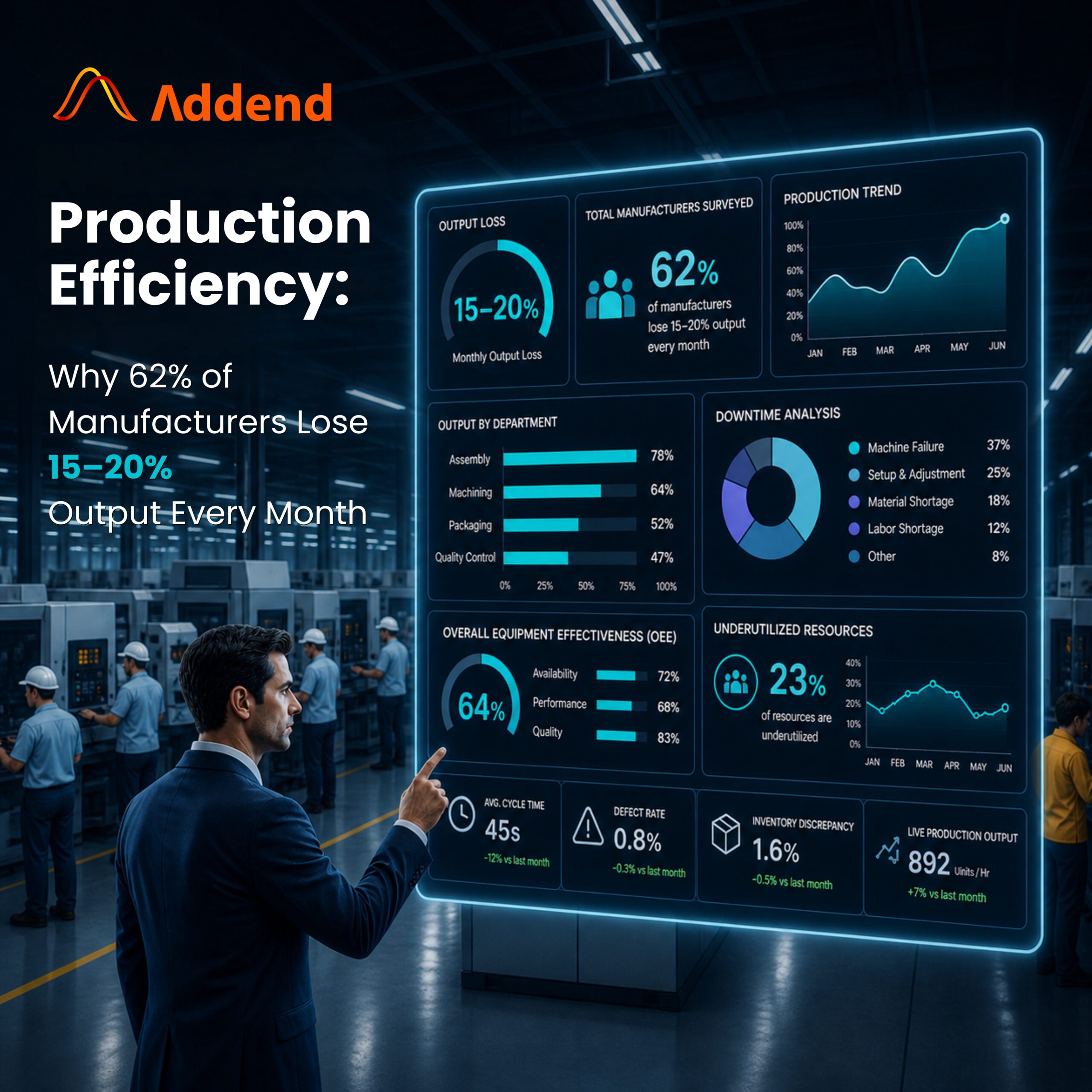
Manufacturing leaders often believe that if machines are running and orders are coming in, production is on track. Production schedules are created, teams are aligned, and plant capacity appears sufficient. Yet by the end of the month, many manufacturers still fall short of production targets.
Production plans look achievable at the beginning of the month. Operations teams feel confident about delivery timelines. Plant capacity appears sufficient. However, as the month progresses, output begins to drop without a clear explanation.
Machines experience short downtime.
Production slows due to minor bottlenecks.
Material delays affect workflow.
Labor productivity fluctuates.
Individually, these issues seem small. However, when combined, they quietly reduce production output by 15–20% every month. This is why nearly 62% of manufacturers lose significant output despite having sufficient capacity.
The challenge is not production capacity.
The challenge is production efficiency.
Production Targets Are Set, But Output Still Falls Short
Most manufacturing companies create production plans based on machine capacity, workforce availability, and expected demand. These plans assume operations will run smoothly. However, real-world manufacturing environments rarely operate without disruptions.
For example, consider a manufacturing plant planning to produce 10,000 units per month. During the month, one machine experiences 20 minutes of downtime per shift. Since the plant runs three shifts, this results in one hour of downtime every day. At the same time, a small bottleneck in packaging slows output slightly, and occasional material delays disrupt workflow.
Each issue appears manageable individually. However, when combined, these inefficiencies reduce daily production output. By the end of the month, the plant produces only 8,400 units instead of 10,000. The company loses 16% of expected output without any major breakdown or operational failure.
This is how production efficiency quietly impacts manufacturing performance.
Hidden Machine Downtime Reduces Output Without Notice
Machine downtime is one of the most common causes of production inefficiency. Many manufacturers track major breakdowns but overlook short downtime events that occur throughout the day.
For example, a manufacturing company producing metal components noticed that production output fluctuated daily. There were no major machine failures, yet output continued to decline. After reviewing operational data, leadership discovered that one critical machine stopped frequently for small adjustments and minor maintenance.
Each downtime lasted 10–15 minutes, which seemed insignificant. However, these interruptions occurred multiple times daily. Over a month, these short stoppages resulted in 18 hours of lost production time, reducing total output significantly.
Once the maintenance team addressed calibration and preventive maintenance schedules, downtime reduced, and production output improved without adding new equipment.
Production Bottlenecks Quietly Slow the Entire Line
Production bottlenecks often develop gradually and impact throughput across the entire production line. When one process slows down, other processes must adjust, leading to reduced output.
For instance, a packaging manufacturer experienced slower output despite smooth upstream production. Cutting and printing processes operated efficiently, but packaging ran slightly slower due to manual handling. Initially, this difference appeared small, but over time, inventory piled up before the packaging stage.
Eventually, upstream machines slowed down to match packaging capacity. By the end of the month, production output dropped by nearly 14%. After identifying the bottleneck, the company improved packaging workflows and automated certain tasks. This small improvement increased overall production output significantly.
Labor Productivity Impacts Production Efficiency
Workforce productivity plays a critical role in production efficiency. Even minor variations in productivity can significantly affect output over time.
Consider a manufacturing company operating three shifts. Leadership expected consistent output across all shifts. However, production reports showed lower output during the night shift. Initially, this difference appeared minor, but over time, it reduced total monthly production.
After analyzing operations, leadership discovered that the night shift experienced delays due to manual material handling and limited supervision. Once workflows were optimized and training was provided, productivity improved, and output increased.
Without identifying this issue, the company would have continued losing production capacity every month.
Material Delays Disrupt Production Flow
Material availability is another hidden factor affecting production efficiency. Even small delays can disrupt schedules and reduce output.
For example, a manufacturing company producing consumer goods experienced occasional delays in raw material availability. Production teams adjusted schedules temporarily, but repeated delays slowed operations. Over time, these disruptions reduced overall production efficiency.
After improving inventory planning and supplier coordination, material availability stabilized. As a result, production output improved, and operational efficiency increased.
This example highlights how material delays quietly impact production performance.
Why Traditional Reporting Fails to Improve Production Efficiency
Most manufacturing organizations rely on daily or weekly production reports. These reports summarize output numbers but rarely explain why output declines.
For example, leadership may notice that production fell short by 15%. However, they may not know whether the issue occurred due to downtime, bottlenecks, labor productivity, or material delays. Teams then spend time investigating, and corrective actions are delayed.
During this time, inefficiencies continue, and production output remains inconsistent.
Traditional reporting explains what happened.
It does not prevent what will happen next.
Improving Production Efficiency Through Operational Visibility
Manufacturers that improve production efficiency focus on operational visibility. Real-time insights help leaders identify issues early and take corrective action.
For example, a mid-size manufacturing company implemented a real-time production dashboard to monitor machine utilization and throughput. Within weeks, leadership identified frequent short downtime events that previously went unnoticed. After addressing these issues, production output increased without expanding capacity.
Similarly, another manufacturing organization used operational visibility to identify shift-based productivity gaps. By optimizing workflows, the company improved production efficiency and stabilized output.
These improvements were achieved through better visibility and faster decision-making.
What We’ve Observed Across Mid-Size Manufacturing Organizations
Across multiple manufacturing environments, organizations that improve production efficiency experience measurable improvements. Output becomes more consistent, delivery performance improves, and operational stress reduces.
Teams move from reactive problem-solving to proactive decision-making. Production schedules stabilize, and operational efficiency improves. Most importantly, organizations recover lost output without increasing production capacity.
This leads to improved profitability and stronger operational performance.
Addend Perspective
At Addend Analytics, production efficiency is often viewed as a visibility challenge rather than a capacity issue. Many manufacturing organizations already have sufficient production capacity but lose output due to hidden inefficiencies.
By improving operational visibility, leaders gain clarity into where production slows down and why. This allows teams to take faster action and improve production efficiency.
Organizations that adopt this approach often recover 15–20% of lost output within months.
Manufacturing companies do not always lose output due to major failures. Most losses occur through small inefficiencies that accumulate over time. Without visibility, these inefficiencies remain hidden and impact production performance.
Improving production efficiency helps manufacturers recover lost output, reduce operational costs, and improve delivery performance.
Production efficiency is not about working harder.
It is about removing the small inefficiencies that slow production every day.
Talk to Our Manufacturing Analytics Experts
Hidden inefficiencies may be reducing your production output without visibility. Our experts help you identify gaps, improve efficiency, and increase output with real-time analytics.
Talk to our experts today:
https://addendanalytics.com/contact-us
Author By

Kamal Sharma
Kamal brings over 20 years of experience in data analytics and business intelligence. He has led the design and implementation of analytics solutions across operations, financial reporting, and performance improvement initiatives. With a background in business statistics and Six Sigma, his work focuses on applying data in a structured and practical way to solve real business challenges.