
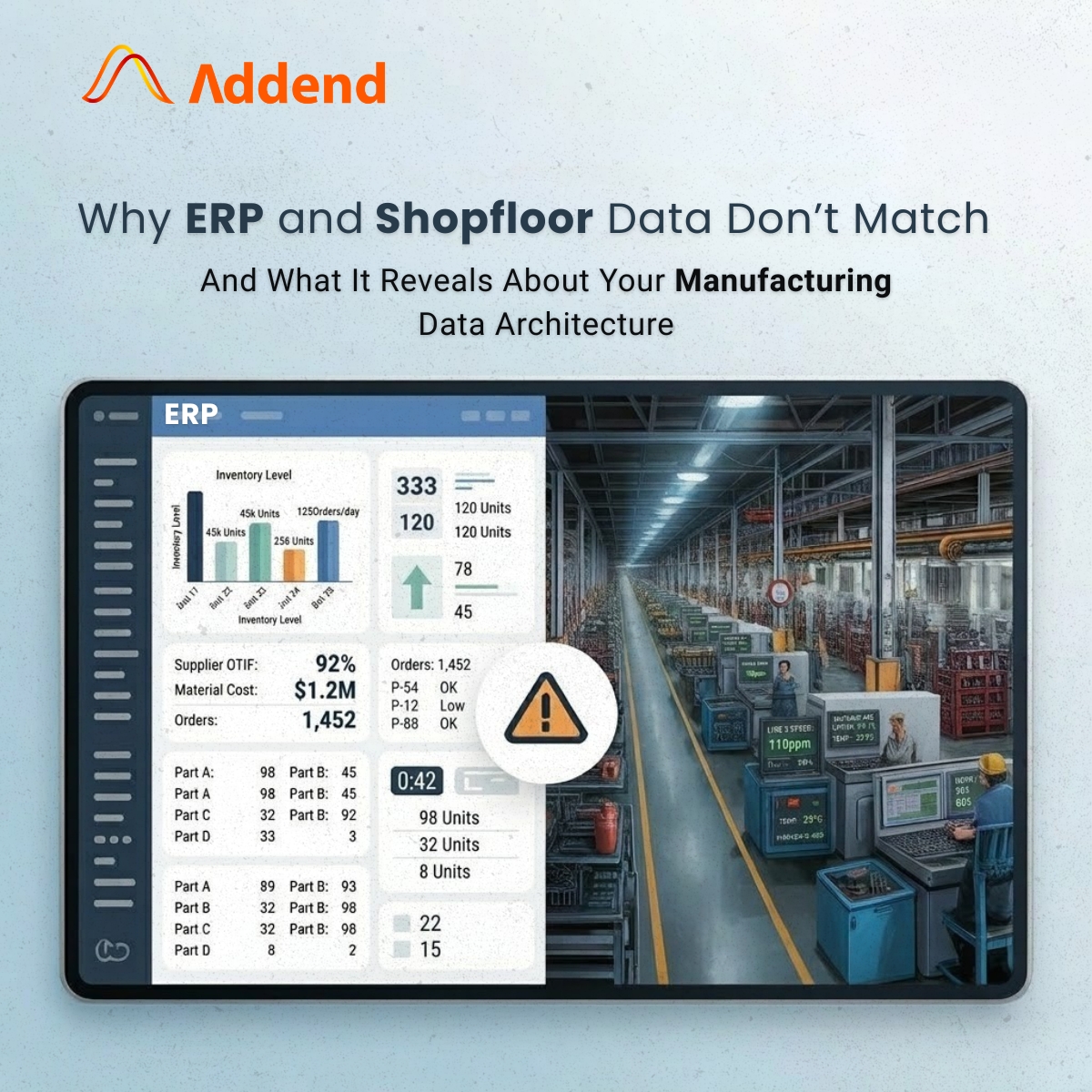
Why ERP and Shopfloor Data Don’t Match — And What It Reveals About Your Manufacturing Data Architecture
When the plant manager raises it in the weekly ops review — that the ERP numbers don’t match what the shopfloor is reporting — the first instinct is to treat it as an integration problem.
“We need better connectors between the MES and SAP data.”
“We need real-time data feeds into the data lake from the shopfloor.”
“We need to upgrade the ETL pipeline.”
So the IT team starts building new connectors. Middleware gets upgraded. Dashboards get deployed. And six months later, the numbers still don’t match. The meetings are still uncomfortable. Nothing has actually changed.
Here is what is really happening.
Your ERP was designed to record transactions — planned orders, scheduled quantities, standard costs. It captures what should happen. Your shopfloor captures what did happen — real cycle times, unplanned stops, actual scrap. These are two fundamentally different records of reality. Connecting them with a data pipeline does not reconcile them. It just surfaces the conflict in a different place, faster.
We’ve seen this pattern repeatedly across manufacturing organizations. When teams try to scale analytics, the same issues surface — incompatible systems, unclear data structures, and a limited understanding of how data actually flows across the plant. Research has observed the same, but most teams don’t need a report to recognise it — they are already dealing with it daily.
The mismatch between your ERP and shopfloor is not a pipeline problem. It is a structural one. And you cannot fix structure by adding another layer on top of it.
The Risk and Cost of Inaction
If your reaction is “we manage around it,” consider what managing around it is actually costing you — in dollars, in decisions, and in the trust your leadership team has in its own data.
Start with time. In most plants, supervisors, planners, and analysts spend a significant portion of their day reconciling numbers — checking reports, validating outputs, and confirming which version is correct before decisions are made. That time is rarely measured, but it directly reduces the time available to run and improve operations.
Now look at what that broken data is doing to your decisions. McKinsey found that companies with unified data systems are 1.5 times more likely to outperform competitors in making data-driven decisions. The inverse is the uncomfortable truth for most manufacturers: fragmented data does not just slow decisions. It systematically biases them — toward the loudest voice in the room, toward gut feel dressed up as experience, toward whoever prepared their numbers most convincingly before the meeting.
And the financial exposure compounds quietly. Gartner puts the annual cost of poor data quality at an average of $12.9 million per organization. For a $300M manufacturer, the operational version of that number — capacity scheduled against wrong yield figures, customer commitments built on inflated output data, cost structures calculated on planned rather than actual performance — can comfortably exceed that estimate before anyone has flagged a problem.
What makes this harder is that many organizations learn to operate around the problem instead of fixing it. Over time, the mismatch becomes normalized — and improvement initiatives get delayed because the data itself is not trusted.
It will not resolve itself. Every quarter this goes unaddressed is a quarter of hidden inefficiency that nobody owns — because nobody can see it clearly enough to be accountable for it.
The Root Causes — What Is Actually Breaking Down
1. No shared definition of “production”
ERP counts a production order complete when it is confirmed in the system. The shopfloor counts it when the last part clears the final station. Quality counts it after inspection passes. Three functions. Three definitions. One number that can never agree. Until leadership defines what “done” means — precisely, in writing, across all functions — the data will keep diverging at the source.
2. Manual entry introduces lag and bias where it hurts most
In many plants, shopfloor data still depends on manual entry at the end of a shift. This creates predictable issues — delays in recording, inconsistencies in how data is entered, and adjustments made based on judgement rather than exact measurement. Because this data feeds every downstream report, small inaccuracies at the source quickly become larger decision problems.
3. Time stamps live in different realities
ERP transactions post in batch — sometimes hours after the event they record. Shopfloor events happen in real time. When you reconcile them, you are comparing data from different moments in time and treating it as the same shift. The result is not inaccuracy in one system. It is structural misalignment between both — with no clean way to tell which number is closer to the truth.
4. Nobody owns data quality at the point of origin
Machine operators are accountable for parts. Supervisors are accountable for output. Nobody is accountable for whether the data entered is accurate, complete, and timestamped correctly. Data ownership was designed around job function — not around the decisions that data needs to support. That gap is where the mismatch lives.
5. The architecture was built for reporting, not decisions
Without modernized data management, most manufacturing plants default to an ecosystem of spreadsheets maintained by well-intentioned subject matter experts — with data manipulated differently at different plants, making it effectively ungovernable at scale. Most manufacturing data architectures were designed to answer “what happened last month.” When you try to use that same infrastructure to answer “what should I decide right now,” it breaks — because it was never designed for that question.
A Structured Path to Fix This
This is not a transformation program. It is a disciplined sequence — starting with clarity, not software.
Step 1: Define the decision, not the data
Identify the five operational decisions your leadership makes every week — capacity commitments, downtime response, quality holds, shift scheduling, customer delivery promises. For each decision, define the data required: what field, at what frequency, with what tolerance for error. This is your real data specification. Not a system requirement. A decision requirement.
Step 2: Fix the logic before you fix the pipeline
Agree on definitions across operations, finance, and IT. What counts as a completed unit? When does a downtime event begin? What is included in scrap rate? Document it. Get all three functions in the same room. This is the hardest step — not technically, but organizationally. This step cannot be solved by IT alone. The definitions that govern your data sit across operations, finance, and IT — and unless these teams align on how data should behave, the problem simply shifts from one system to another. Getting these teams in the same room to agree on definitions is often the hardest part — and the most important.
Step 3: Run a focused pilot — six to eight weeks
Pick one line. One shift. One decision. Build the data flow for that specific context. Capture shopfloor events at the source — through machine signals, barcode confirmation, or operator-verified timestamps at the moment of occurrence. Feed clean data through a reconciliation layer before it touches the ERP. Measure gap reduction. The goal of this step is simple — to demonstrate, in a controlled environment, that the gap can be reduced and decisions can improve. Once that is visible, scaling becomes a practical step rather than a theoretical plan.
Step 4: Validate that decisions are actually changing
Do not measure success by dashboard adoption. Measure it by decision behavior. Are planners scheduling against real yield rather than planned yield? Are supervisors catching downtime patterns within the same shift rather than the next morning’s review? If behavior has not changed, the architecture has not succeeded — regardless of what the dashboard looks like.
Step 5: Scale with governance, not just technology
Before you expand plant-wide, establish data governance. Who owns each data element? Who resolves conflicts when systems disagree? What is the escalation path when the numbers don’t match? Governance ensures that as complexity increases, the data remains reliable enough to support decisions consistently.
You Know This Is Working When…
Your operations review starts with one number — not three.
Your planners have stopped maintaining shadow spreadsheets because they trust what the system shows.
Your CFO stops asking “which report is right” and starts asking “what are we going to do about it.”
Your shopfloor supervisors can see cost implications within the shift — not at month-end close.
Your ERP reconciliation takes hours, not days.
The outcomes are measurable when the architecture is right: one automotive manufacturer using real-time, accurate data for operational decision-making reduced cost per unit by 3.5%, while another cut unplanned downtime on a critical asset by 25% through connected data analytics.
These outcomes are achievable when the underlying data architecture is aligned — not because of a new tool, but because the system is finally able to reflect what is actually happening on the shopfloor in a consistent and usable way.
How Addend Approaches This
Most analytics vendors lead with a bunch of dashboards. Addend starts with a different question: what decision are you trying to make — and does your current data architecture actually support it?
That means examining your ERP data structure, your shopfloor capture points, your reconciliation logic, and your governance gaps before recommending a single technology change. It means working with your IT and operations teams together, because the problem lives precisely in the gap between them.
The goal is not a nicer looking report. The goal is a CIO who can walk into an ops review and say — with full confidence — “here is what actually happened on the floor, and here is what we are doing about it.”
Frequently Asked Questions
Q: We already have a MES. Doesn’t that solve the ERP mismatch?
Not automatically. A MES captures shopfloor events — but if the event definitions, timestamps, and reconciliation logic don’t align with your ERP, the gap persists. The MES is a data source. The architecture is how you make that data trustworthy across systems and functions.
Q: Is this an IT problem or an operations problem?
Both. That is precisely why it rarely gets resolved. IT owns the systems. Operations owns the process. Neither owns the gap between them. A manufacturing data strategy requires both functions to agree on definitions, ownership, and governance — in the same room, at the same time.
Q: How long before we see results?
A focused pilot on one line, one shift, one decision can show measurable gap reduction in six to eight weeks. You do not need to wait for plant-wide rollout to start making better decisions. Start narrow. Prove it. Then scale.
Q: We are mid-ERP implementation. Should we wait until it is live?
No — and this is a common and costly mistake. Once an ERP is live and embedded in daily operations, changing data flows and field definitions becomes significantly more expensive. Address data architecture during implementation, not after.
Q: What if our shopfloor doesn’t have IoT infrastructure?
You do not need a fully connected factory to start. Structured operator-confirmed data capture — with agreed definitions, clear timestamps, and accountability at the source — can dramatically improve data quality without major capital investment. Fix the process first. Layer in technology second.
Book a Manufacturing Analytics Assessment
If your ERP and shopfloor numbers don’t match, you already know something is structurally wrong. The question is how much it is costing you — and how much longer you are prepared to wait.
In a 30-minute Manufacturing Analytics Assessment, Addend will:
- Identify precisely where your ERP and shopfloor data diverge — and why
- Map the specific decisions currently being made on unreliable data
- Show you what a decision-first data architecture looks like for your environment
- Provide a clear, phased roadmap — no commitment required
Email: info@addendanalytics.com
Phone: Available on the website
Addend Analytics helps manufacturing leaders build decision-first data architectures — closing the gap between what ERP reports and what the shopfloor knows.
Author By

Rajeshwari Sharma
Rajeshwari is an experienced data professional with a track record of using data-driven insights to improve business performance. She has successfully managed multiple projects, utilising her expertise in data analysis and database administration. As a Microsoft-certified Data Analyst and Azure Database Administrator, she has cultivated a deep understanding of data management best practices and advanced analytics techniques. Her MBA in Business Analytics has equipped her with a solid foundation for integrating business strategy with data insights.