
Predictive analytics is no longer an emerging capability. For most organizations, it is an expected one. Forecasting demand, anticipating risk, predicting outcomes, and optimizing decisions have become baseline requirements across finance, operations, and commercial teams.
What remains unclear for many leaders is how predictive analytics should be implemented in a way that scales, stays governed, and delivers a measurable return on investment, especially within the Microsoft ecosystem.
Microsoft Fabric is increasingly positioned as the platform that unifies analytics, data engineering, and AI. But adopting Fabric alone does not guarantee predictive analytics success. Outcomes depend on architectural design, cost discipline, and how closely predictions are tied to real business decisions.
This article explains how predictive analytics works on Microsoft Fabric, what actually drives cost, and how organizations evaluate ROI beyond model accuracy.
What Predictive Analytics Means in an Enterprise Context
Predictive analytics refers to the use of historical and current data to estimate future outcomes. In enterprise environments, this typically includes:
- Forecasting revenue, demand, or capacity
- Predicting operational risk or failure
- Anticipating customer behavior
- Estimating financial exposure under different scenarios
What differentiates enterprise predictive analytics from experimentation is not the algorithm. It is repeatability, governance, and decision relevance.
According to Gartner, predictive analytics initiatives fail to scale when they remain disconnected from production data platforms and operational workflows. The issue is rarely statistical capability. It is architectural fragmentation.
This is the gap Microsoft Fabric is designed to address.
Why Microsoft Fabric Is Suited for Predictive Analytics
Microsoft Fabric brings predictive analytics closer to operations by collapsing multiple layers of the analytics stack into a single platform.
At a platform level, Fabric combines:
- Unified data storage through OneLake
- Integrated data engineering and analytics workloads
- Native alignment with Power BI and Azure AI services
- Shared governance, security, and access controls
For predictive analytics, this matters because models, reports, and decisions rely on the same data foundation and definitions. When predictive outputs diverge from official analytics, trust collapses quickly.
Fabric reduces this risk, but only when implemented intentionally.
Reference Architecture for Predictive Analytics on Microsoft Fabric
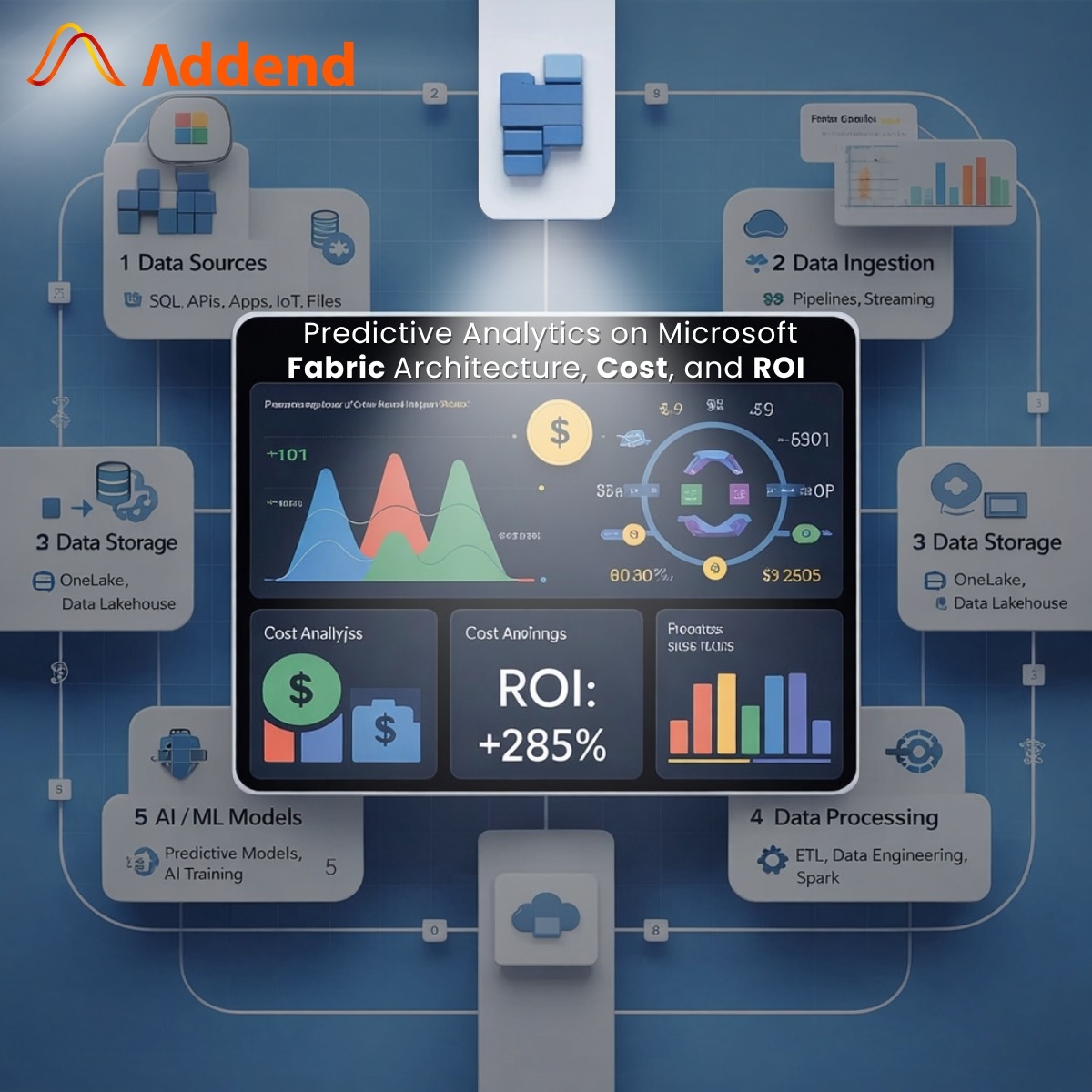
A predictive analytics architecture on Microsoft Fabric is best understood as a closed loop system, not a linear pipeline.
Data Foundation (OneLake)
All predictive workloads should operate on a single, shared data foundation. OneLake enables data to be stored once and reused across analytics, machine learning, and reporting without duplication.
This reduces:
- Conflicting datasets
- Reconciliation effort
- Storage and compute waste
Data Engineering for Prediction, Not Just Reporting
Predictive analytics places different demands on data engineering. Pipelines must support:
- Historical depth for model training
- Consistent feature generation
- Data freshness aligned to prediction cadence
Engineering pipelines optimized only for reporting often fail when reused for predictive workloads.
Feature and Semantic Consistency
Predictions must align with how the business measures performance. This requires:
- Shared feature definitions
- Governed semantic models
- Consistent aggregation logic
Without this layer, predictive outputs contradict dashboards, undermining adoption.
Model Development and Deployment
Fabric’s integration with Azure machine learning services allows models to be trained and deployed directly against governed datasets. This reduces handoffs and accelerates movement from experimentation to production.
Consumption and Action
Predictions are surfaced through analytics tools, embedded workflows, or decision support interfaces. Outcomes and feedback flow back into the platform, improving future predictions.
This architecture supports predictive analytics as an operational capability, not a side project.
Book a 30-minute Predictive Analytics Assessment
Understand whether your Microsoft Fabric environment is built to deliver predictive ROI or just technical capability.
The Real Cost Drivers of Predictive Analytics on Fabric
For CFOs, the cost of predictive analytics is often misunderstood. Model development is rarely the largest expense.
The true cost drivers include:
- Data Duplication and Reprocessing
Fragmented architectures multiply storage and compute costs. Fabric’s unified model reduces this, but only if duplication is eliminated intentionally.
- Rework and Pipeline Maintenance
According to McKinsey, organizations lose 30–40% of potential analytics and AI value due to rework caused by inconsistent data foundations and duplicated logic.
- Governance Overhead
When governance is layered on after the fact, it increases cost and slows adoption. Embedding governance into Fabric architecture reduces long-term overhead.
- Low Adoption of Predictions
Predictions that are not trusted or used represent sunk cost. Adoption, not accuracy, is the primary ROI lever.
How Leaders Evaluate ROI from Predictive Analytics
ROI from predictive analytics is rarely captured through a single metric. Mature organizations evaluate value across four dimensions:
- Decision Improvement
Are decisions measurably better than before? Examples include improved forecast accuracy, reduced variance, or faster response times.
- Cost Avoidance
Predictive insights often prevent losses rather than generate revenue. This includes avoiding downtime, reducing inventory exposure, or mitigated financial risk.
- Productivity Gains
Analytics and AI that reduce manual analysis free up high cost talent for higher value work.
- Scalability
Can predictive capabilities be reused across use cases without rebuilding pipelines and models?
Organizations that design predictive analytics on a unified platform achieve ROI faster because value compounds across use cases.
Common Mistakes in Predictive Analytics Implementations
Predictive analytics initiatives on Fabric stall when organizations:
- Treat Fabric as a reporting migration only
- Build models on curated POC datasets
- Ignore semantic alignment between analytics and predictions
- Measure success by model accuracy alone
- Delay governance until after deployment
These mistakes increase cost while reducing confidence.
Addend Analytics’ Perspective
Addend Analytics approaches predictive analytics on Microsoft Fabric as a decision enablement discipline, not a data science exercise.
The focus is on:
- Identifying decisions where prediction changes outcomes
- Designing Fabric architectures that support reuse and governance
- Aligning predictive models with operational analytics
- Validating ROI early through focused accelerators and POCs
This approach helps organizations move from predictive experimentation to predictive intelligence that leadership is willing to act on.
Predictive analytics delivers value only when it is trusted, operational, and aligned with real decisions. Microsoft Fabric provides a strong foundation, but outcomes depend on architectural discipline and cost awareness.
For CIOs and CFOs, the question is not whether predictive analytics is worth pursuing. It is whether the platform and operating model are designed to let value compound rather than fragment.
Organizations that answer that question early reduce cost, accelerate adoption, and realize ROI sooner.
Talk to a Microsoft Fabric Predictive Analytics Expert
Author By

Kamal Sharma
Kamal brings over 20 years of experience in data analytics and business intelligence. He has led the design and implementation of analytics solutions across operations, financial reporting, and performance improvement initiatives. With a background in business statistics and Six Sigma, his work focuses on applying data in a structured and practical way to solve real business challenges.