
From Reactive Chaos to Autonomous Resilience
For decades, supply chain management has been a reactive game a constant struggle to recover from disruptions after they occurred.
A port closure. A sudden demand spike. A supplier bankruptcy. Any of these events would send shockwaves through the network, often requiring weeks of frantic manual replanning.
In 2026, that era is ending.
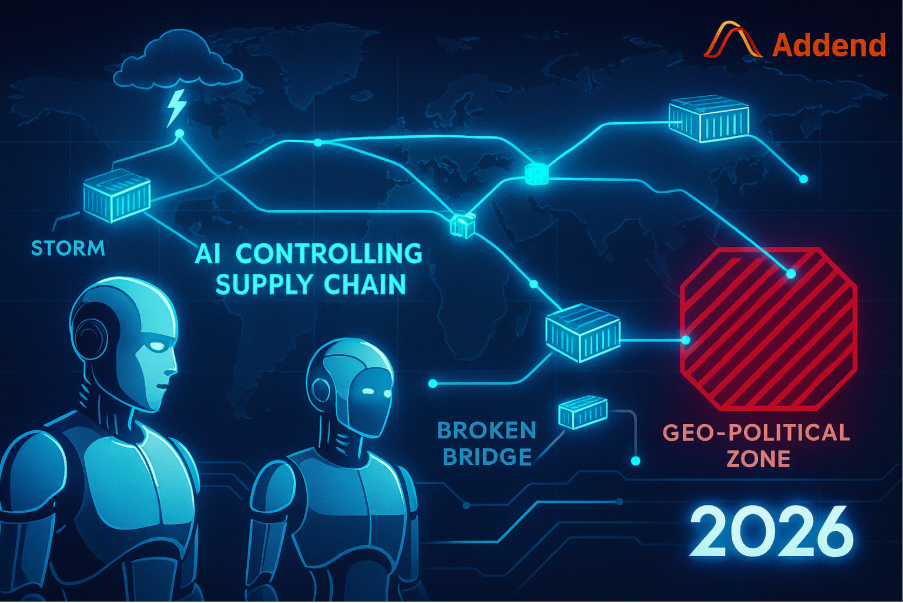
The rise of autonomous AI agents is transforming supply chains from fragile, reactive networks into proactive, self-healing ecosystems. These intelligent agents don’t just forecast they perceive, reason, act, and collaborate rerouting shipments, renegotiating contracts, and rebalancing inventories in real time, with zero human intervention.
What Are AI Agents in Supply Chain?
AI agents are goal-oriented, autonomous software entities that go far beyond traditional analytics and dashboards.
They can:
- Perceive their environment (the live supply chain)
- Reason about complex, multi-variable situations
- Take independent actions
- Collaborate with other agents (inside and outside the company)
In modern supply chain operations, a multi-agent system enables:
- Autonomous Re-routing
- Redirecting shipments instantly around weather disruptions, strikes, or geopolitical events
- Dynamic Supplier Negotiation
- AI agents talking directly to supplier systems to secure better pricing or priority on delayed orders
- Predictive Inventory Balancing
- Shifting stock between warehouses based on real-time demand signals
- Self-Healing Logistics
- Automatically detecting failures and activating contingency plans
Real example in seconds:
A critical component is delayed. Instead of sending an alert the agent:
- Scans alternative suppliers
- Compares pricing & lead times
- Places a preliminary order (within budget guardrails)
- Adjusts the master production schedule
— all autonomously.
Traditional response (2020s):
Days of chaos emergency meetings, Excel firefighting, partial line shutdowns, angry customers.
2026 AI-agent response:
Monitoring Agent detects the strike calculates:
“Battery shipments from Supplier A delayed 5 days production shutdown risk in
72 hours.”
- Logistics Agent instantly:
Books air freight for critical volume
Reroutes trucks to alternate port
- Procurement Agent negotiates autonomously with Supplier B’s AI:
Secures 2,000 extra units at 10% premium (within pre-approved rules)
- Inventory Agent reallocates existing stock:
Prioritizes highest-margin vehicle lines
- Planning Agent updates master schedule & communicates revised (minimally impacted) delivery dates to dealers
Result: Catastrophic disruption absorbed in minutes.
Zero human intervention. Minimal cost increase. On-time delivery preserved.
How AI Agents Actually Work (The Architecture)
This level of autonomy rests on a layered, intelligent stack:
- Perception Layer
Real-time feeds: IoT sensors, GPS, market news, weather APIs, customs data, social sentiment
- Multi-Agent Society
Specialized agents (Logistics, Procurement, Inventory, Demand, Planning, Sustainability…) constantly communicating and negotiating
- Reasoning & Negotiation Engine
Powered by advanced LLMs + reinforcement learning agents reason, simulate outcomes, negotiate with humans and other companies’ agents
- Execution & Feedback Loop
Agents act within strict guardrails (budgets, risk tolerances, compliance rules) every decision feeds back for continuous learning
We are moving from supply chain management supply chain autonomy.
Key Benefits for Forward-Looking Organizations
- Hyper-Resilience
Weeks-long disruptions resolved in minutes
- Unprecedented Efficiency
Simultaneous optimization across cost, speed, sustainability, finding solutions humans miss
- Freed-Up Human Talent
Supply chain teams move from firefighting strategic network design & agent governance
- Real-Time Visibility & Control
True end-to-end, second-by-second transparency
- Competitive Agility
Pivot faster than competitors still stuck in weekly planning cycles
Challenges We Must Solve
The autonomous supply chain is powerful — but not magic. Key considerations:
- The “Black Box” Problem
Explainability, audit trails, and “why did the agent do that?” traceability are non-negotiable
- Inter-Company Agent Communication
Industry standards and secure protocols for agent-to-agent negotiation
- Cybersecurity Risks
Agents with purchasing power = high-value targets. Zero-trust architecture required
- Guardrails & Governance
Clear rules on risk appetite, spend limits, ethical boundaries — with continuous human oversight
Conclusion: The Future Belongs to the Autonomous
In 2026, AI agents mark the biggest shift in supply chain history since the containerization revolution.
We have moved beyond predicting disruptions we now build intelligent systems that adapt instantly, turning potential disasters into minor data points in a continuous optimization loop.
The companies that will dominate tomorrow are the ones that learn to trust their digital workforce to navigate complexity at machine speed.
The future of supply chains isn’t just visible.
It’s autonomous, collaborative, and extraordinarily resilient.
Author By

Rajeshwari Sharma
Rajeshwari is an experienced data professional with a track record of using data-driven insights to improve business performance. She has successfully managed multiple projects, utilising her expertise in data analysis and database administration. As a Microsoft-certified Data Analyst and Azure Database Administrator, she has cultivated a deep understanding of data management best practices and advanced analytics techniques. Her MBA in Business Analytics has equipped her with a solid foundation for integrating business strategy with data insights.