
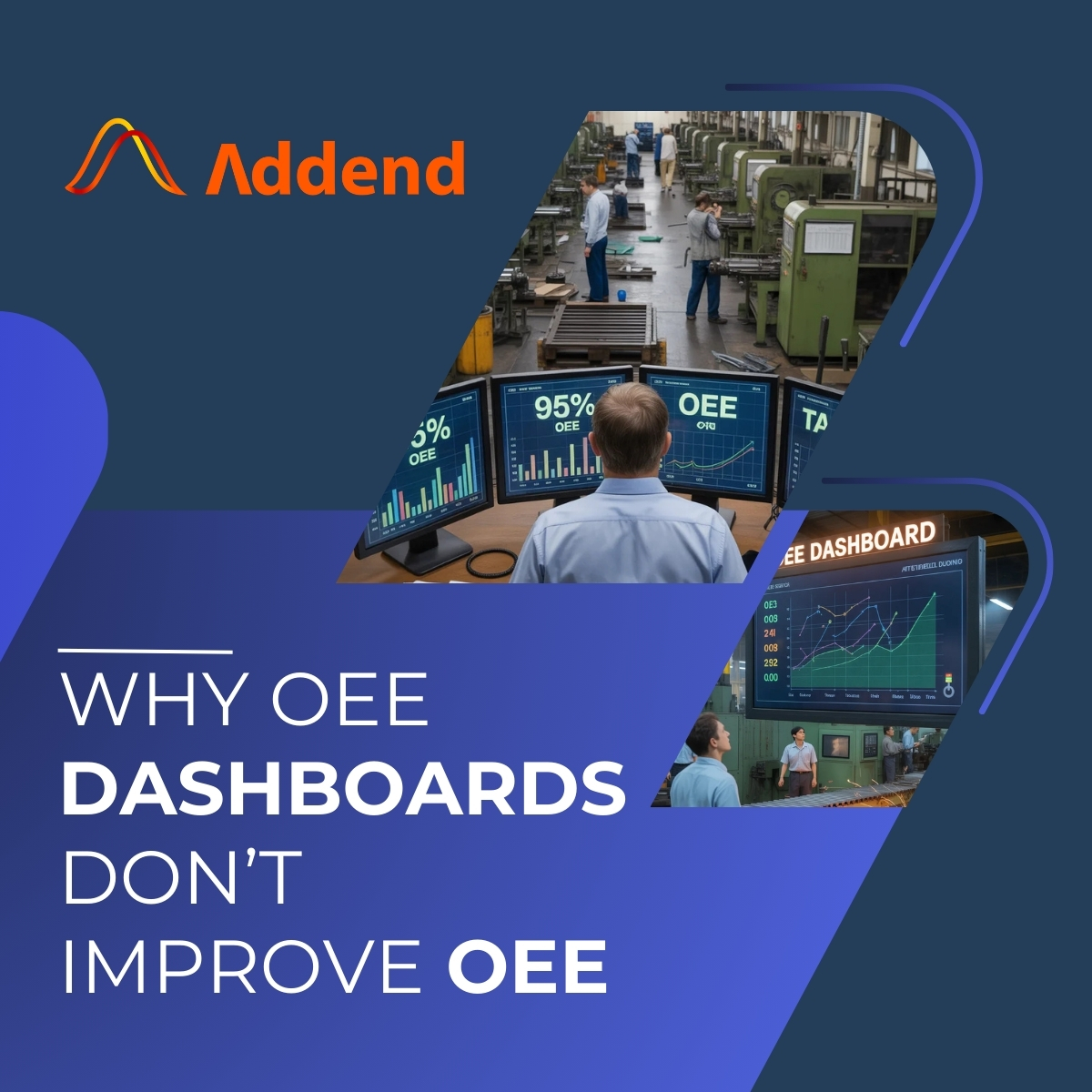
Most manufacturing plants already track OEE.
They have dashboards.
They have charts.
They have daily, weekly, and monthly views.
Yet OEE still doesn’t improve.
This creates a quiet frustration for manufacturing leaders:
“We can see OEE clearly, so why doesn’t performance change?”
The uncomfortable truth is this:
Seeing OEE is not the same as improving OEE.
And dashboards, by themselves, rarely change how people act.
The False Assumption Behind Most OEE Dashboards
Most OEE dashboards are built on one assumption:
If people can see OEE, they will improve it.
That assumption sounds logical.
It also explains why so many OEE initiatives stall.
Because improvement doesn’t come from visibility.
It comes from better decisions, made at the right time.
This is where OEE dashboards quietly fail.
OEE Is Reviewed. But OEE Decisions Are Not Clear.
In many plants, OEE is reviewed like this:
- Yesterday’s OEE is shown
- Variance is discussed
- Root causes are debated
- Actions are “noted”
Then the shift moves on.
What’s missing is not data.
What’s missing is a clear decision moment.
No one is certain:
- Who must act
- When they must act
- What exactly they should change
Without that clarity, OEE becomes a scorecard, not a control lever.
A Real Decision Moment OEE Should Support (But Often Doesn’t)
Let’s make this practical.
Every morning, a plant supervisor looks at yesterday’s OEE.
At that moment, they must decide:
- Do we intervene today or let the line run?
- Is this loss mechanical, process-related, or staffing-related?
- Should we prioritize maintenance, retraining, or throughput?
If the OEE dashboard does not directly support that choice, it adds little value.
Most dashboards stop at:
- Availability %
- Performance %
- Quality %
They don’t answer:
“What should I do differently today?”
This is why OEE dashboards don’t improve OEE
Why OEE Dashboards Feel Useful, but Don’t Change Outcomes
OEE dashboards feel useful because they are:
- Structured
- Familiar
- Quantified
But usefulness in meetings is not the same as usefulness in operations.
Here’s where they fall short.
Problem 1: OEE Is Reviewed Too Late
In many plants, OEE is reviewed:
- At end of shift
- In daily meetings
- In weekly reviews
By then, losses are already locked in.
You cannot recover yesterday’s downtime.
You cannot undo yesterday’s scrap.
Improvement requires earlier decisions, not clearer summaries.
Problem 2: OEE Explains Losses After They Happen
Most dashboards are designed to explain:
- What went wrong
- Where losses occurred
- How much was lost
That’s valuable for learning.
But learning alone does not improve today’s performance.
Improvement happens when analytics supports intervention before losses accumulate.
Problem 3: OEE Dashboards Create Discussion, Not Direction
Many OEE reviews sound like this:
- “Performance dropped on Line 3”
- “Availability was affected by maintenance”
- “Quality losses increased slightly”
These statements are descriptive.
But description does not equal direction.
If the dashboard does not clearly signal:
- Intervene now
- Let it run
- Escalate immediately
People default to discussion instead of action.
The Real Reason OEE Dashboards Fail
OEE dashboards fail because they are designed around measurement, not decision-making.
They answer:
- “What is OEE?”
- “How did we perform?”
They do not answer:
- “What decision should change right now?”
This distinction matters.
Because analytics that does not change a decision does not change performance.
What Improving OEE Actually Requires
Improving OEE is not about tracking OEE better.
It is about changing behaviour during execution, not after review.
That requires analytics that is:
- Timed to decisions
- Tied to specific actions
- Clear about trade-offs
This is where decision-ready analytics becomes essential.
What Decision-Ready OEE Analytics Looks Like
Decision-ready analytics starts with the decision, not the metric.
Instead of asking:
“How is OEE trending?”
It asks:
“What should we do in the next shift to prevent further loss?”
This changes how OEE is used.
Example: Decision-Ready vs Dashboard-Only OEE
Dashboard-only view:
- OEE dropped to 62%
- Performance loss is the main driver
Decision-ready view:
- Performance loss crossed intervention threshold
- Maintenance action within next 4 hours prevents full-shift loss
Same data.
Very different outcome.
This is how analytics starts improving OEE.
Why Manufacturing Leaders Get Stuck With Dashboards
Manufacturing leaders don’t choose dashboards because they are ineffective.
They choose them because dashboards feel:
- Objective
- Safe
- Complete
But leadership is not about waiting for complete data.
It’s about making the best possible decision at the right time.
Decision-ready analytics helps leaders act earlier, without feeling reckless.
The CIO’s Blind Spot Around OEE
Many CIOs invest heavily in:
- Data integration
- Visualization
- Reporting speed
But they rarely ask:
- Which OEE decision is this improving?
- When will that decision be made?
Without those answers, OEE dashboards become technically strong, and operationally weak.
Why More Real-Time Data Alone Doesn’t Fix OEE
Some organizations try to fix the problem by making OEE more real-time.
This often backfires.
When everything updates constantly:
- Teams hesitate
- Signals become noisy
- Confidence drops
Decision-ready analytics is not about speed alone.
It is about clarity at the moment of choice.
The Shift That Actually Improves OEE
The shift is not from:
- Manual → automated
- Static → real-time
- Reports → dashboards
The real shift is from:
- Measurement-first → decision-first
When analytics is built around decisions:
- Fewer metrics matter
- Actions become clearer
- Improvement accelerates
This is how OEE actually improves.
A Simple Test for Your OEE Dashboard
Ask one question:
“What decision does this dashboard help someone make today?”
If the answer is unclear, OEE will not improve, no matter how accurate the data is.
Why This Problem Keeps Repeating
OEE dashboards have existed for decades.
So why hasn’t the problem been solved?
Because technology evolved faster than decision design.
Tools improved.
Visuals improved.
But the thinking stayed the same.
Decision-ready analytics fixes the thinking first.
The Takeaway for Manufacturing Leaders
OEE dashboards don’t improve OEE.
Decisions do.
If analytics does not:
- Clarify action
- Reduce hesitation
- Support earlier intervention
It will always feel helpful, but deliver little change.
Improving OEE requires shifting from:
- “What happened?”
to:
- “What should we do next?”
That shift, not the dashboard, is what drives results.
1. Why do most OEE dashboards fail to improve performance?
Most OEE dashboards fail because they show results after losses have already happened.
They explain what went wrong, but they don’t help supervisors decide what to do next, right now.
Without a clear decision tied to the number, OEE becomes a review metric, not a control tool.
2. Is tracking OEE still important if dashboards don’t improve OEE?
Yes, tracking OEE is important, but tracking alone is not enough.
OEE becomes valuable only when it is connected to specific actions, such as when to intervene, escalate, or adjust the plan. The problem isn’t OEE itself, it’s how OEE is used.
3. What is the difference between an OEE dashboard and decision-ready OEE analytics?
An OEE dashboard answers:
“What was our OEE?”
Decision-ready OEE analytics answers:
“What should we do now to prevent further loss?”
The difference is not the data, it’s whether the analytics supports a real decision at the right time.
4. Why reviewing OEE daily or weekly is often too late?
By the time OEE is reviewed daily or weekly, the losses are already locked in.
Downtime, scrap, and performance loss cannot be recovered after the shift ends.
Improvement requires decisions during execution, not after reporting.
5. How should manufacturing leaders think differently about OEE improvement?
Manufacturing leaders should stop asking:
“How do we visualize OEE better?”
And start asking:
“Which decisions does OEE need to improve today?”
When OEE is designed around decision moments, fewer metrics are needed, and performance improves faster.
If your OEE dashboard explains losses instead of preventing them, it’s not doing its job.
Shift from OEE reporting to decision-ready analytics.
At Addend Analytics, we help manufacturing leaders redesign OEE analytics around real decision moments, so supervisors know when to intervene, what to change, and why it matters.
Stop reviewing OEE after the shift.
Start improving it before the next one begins.
Author By

Kamal Sharma
Kamal brings over 20 years of experience in data analytics and business intelligence. He has led the design and implementation of analytics solutions across operations, financial reporting, and performance improvement initiatives. With a background in business statistics and Six Sigma, his work focuses on applying data in a structured and practical way to solve real business challenges.