
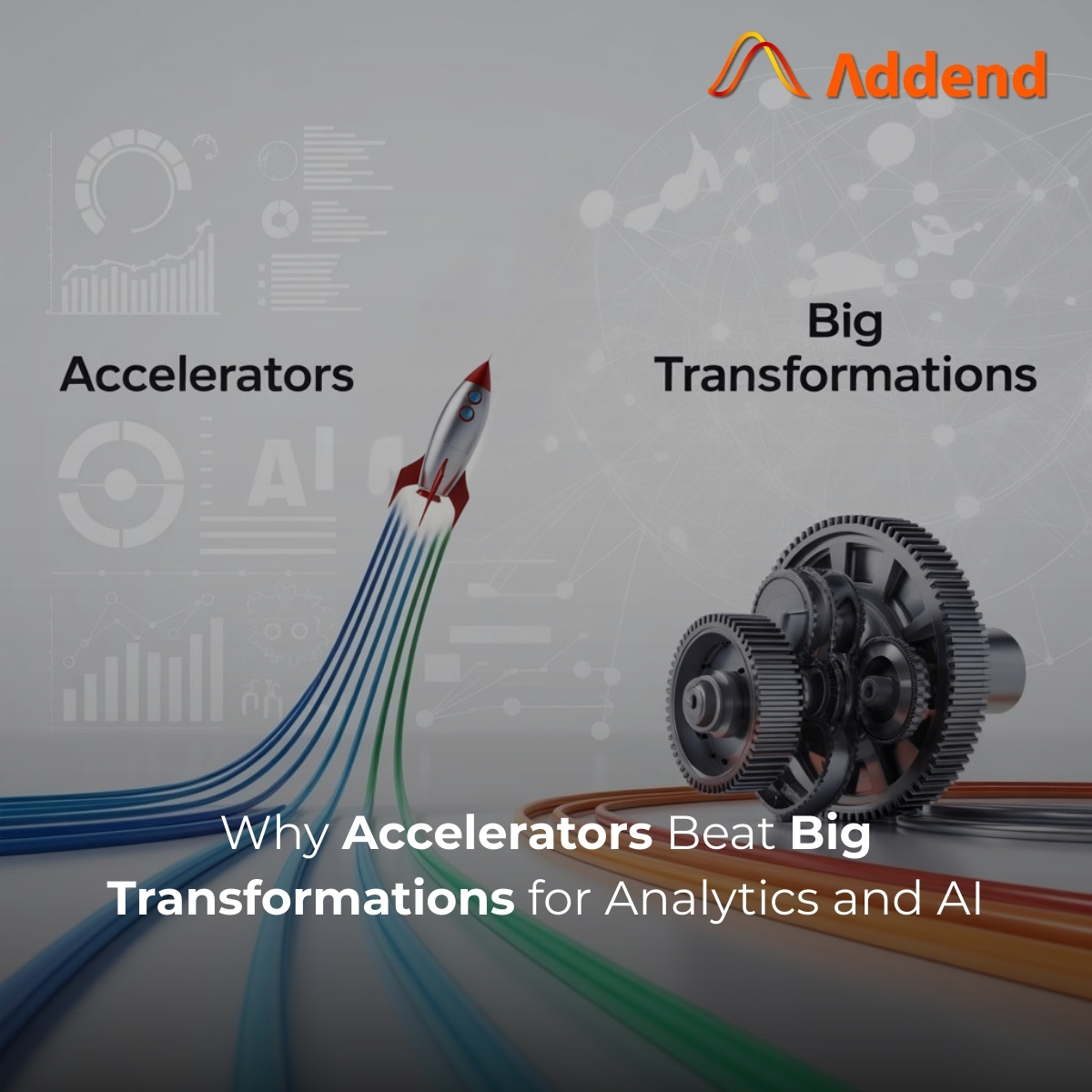
For years, analytics and AI progress have been framed as a transformation problem. Large roadmaps. Multi-year programs. Enterprise-wide redesigns. Centralized platforms meant to “solve analytics once and for all.”
On paper, this approach sounds responsible. In practice, it has become one of the most common reasons analytics and AI initiatives stall, reset, or quietly underdeliver.
Many organizations now find themselves in a familiar situation: significant spend, visible activity, modern platforms, and yet very little change in how decisions are actually made.
This is why a growing number of leaders are stepping back and asking a different question:
Do we really need another transformation, or do we need results faster, with less risk?
That question is where accelerators enter the conversation.
The Hidden Cost of Big Analytics and AI Transformations
Large-scale analytics and AI transformations fail less often because of technical issues and more often because of organizational gravity.
They assume:
- Stable priorities over multiple years
- Perfect alignment across business, IT, and data teams
- Continuous executive sponsorship
- Tolerance for delayed ROI
In reality, none of those conditions reliably hold.
According to repeated industry research from Gartner, a significant percentage of enterprise analytics and AI initiatives fail to deliver expected value, not because the technology is wrong, but because programs take too long to demonstrate impact.
As timelines stretch, three things happen:
- Confidence erodes
- Scope expands without clarity
- Accountability diffuses
By the time results arrive, leadership priorities have often shifted.
Transformation, in theory, promises certainty.
In practice, it often introduces fragility.
Why Analytics and AI Are Especially Poor Fits for “Big Bang” Programs
Analytics and AI behave differently from traditional IT systems.
ERP or core systems can tolerate long stabilization periods because value is binary: the system eventually goes live.
Analytics and AI deliver value incrementally, decision by decision. If those decisions are delayed, the value evaporates.
Large programs struggle because:
- Business definitions evolve faster than roadmaps
- Data complexity increases as scope expands
- AI models require feedback loops that don’t wait for phase gates
- Trust cannot be mandated – it must be earned
This is why many “transformed” analytics platforms still fail to influence operations.
They are complete.
They are modern.
They are just not used to decide.
Accelerators: A Fundamentally Different Way to Build Analytics and AI
Accelerators are often misunderstood as shortcuts or templates.
They are not.
Properly designed analytics and AI accelerators are focused, production-ready implementations built around specific, high-value decisions.
Instead of asking:
How do we transform everything?
Accelerators ask:
Which decisions matter most right now, and what is the fastest, safest way to improve them?
This shift changes everything.
Why Accelerators Win Where Transformations Struggle
1. Accelerators Deliver Proof Before Permission
Large transformations require trust upfront.
Accelerators earn trust through evidence.
They demonstrate:
- How analytics will be used
- How governance works in practice
- How AI behaves in real conditions
This reduces executive skepticism and lowers the political cost of scaling.
2. Accelerators Reduce Risk by Design
By constraining scope, accelerators:
- Limit blast radius
- Reduce integration complexity
- Expose data quality issues early
- Prevent over-engineering
This is particularly important for analytics and AI, where uncertainty is inherent.
Research from McKinsey shows that organizations that pursue incremental, outcome-driven analytics initiatives achieve faster time-to-value and lower rework costs than those pursuing monolithic programs.
3. Accelerators Align Better With How Decisions Are Actually Made
Executives do not think in platforms.
They think in decisions.
Accelerators are built around:
- A specific decision or decision set
- The data required to support it
- The analytics or AI needed to improve it
- The operational context where it will be used
This makes adoption far more natural.
4. Accelerators Compound Instead of Reset
One of the biggest failures of transformation programs is that value resets with leadership change.
Accelerators avoid this by building:
- Reusable semantic models
- Governed data pipelines
- AI-ready foundations
Each accelerator strengthens the platform rather than fragmenting it.
Over time, this creates a true operational analytics and AI ecosystem – without betting everything upfront.
Why Speed Matters More Than Scale Right Now
The analytics and AI landscape is changing faster than most transformation programs can adapt.
Data sources evolve.
AI capabilities shift.
Business priorities change.
In this environment, speed is not recklessness – it is resilience.
Accelerators allow organizations to:
- Learn faster
- Adjust architecture based on reality
- Avoid long-term lock-in to assumptions
They turn analytics and AI into living capabilities, not static programs.
How Addend Analytics Uses Accelerators Differently
Addend Analytics approaches accelerators as production entry points, not proofs of concept.
Each accelerator is designed to answer three questions clearly:
- Which decision improves?
- What data and governance does that decision require?
- What operational outcome should leadership expect?
This ensures accelerators are:
- Aligned to real business outcomes
- Built on Microsoft-native, AI-ready foundations
- Governed from day one
- Designed to scale without rework
Rather than promising transformation later, accelerators deliver decision impact now, while laying the foundation for what comes next.
What an Analytics & AI Accelerator Looks Like for Law Firms
Law firms are a clear example of why large analytics transformations often fail – and why accelerators work better.
Most law firms already have data: time entries, billing systems, matter records, realization rates, and financial reports. The problem is not access. The problem is actionability.
Leadership teams struggle to answer basic but high-stakes questions quickly:
- Which matters are actually profitable – and why?
- Where is margin leaking between pricing, utilization, and write-offs?
- Which clients look healthy on revenue but risky on realization?
- How do we course-correct before financials are finalized?
Large analytics programs attempt to centralize everything at once. They take months, sometimes years, and often stall before partners trust the outputs.
An accelerator-led approach is different.
For law firms, Addend’s accelerators typically focus on a single operational decision first – for example, matter profitability and pricing control.
The accelerator delivers:
- A governed semantic model that aligns time, billing, realization, and write-offs
- Decision-ready views for partners and finance, not just reports
- Early warning indicators for margin erosion during the life of a matter
- A foundation that supports forecasting and AI-driven insights later
Instead of transforming all analytics at once, the firm sees measurable impact within weeks:
- Faster partner decisions
- Fewer reconciliation debates
- Greater confidence in pricing and staffing choices
Once trust is established, the same foundation expands naturally into utilization optimization, client profitability analysis, and predictive financial insights – without rework.
This is how accelerators turn analytics into something partners actually use, not just review.
View Analytics & AI Accelerators for Law Firms
See how decision-led accelerators deliver faster impact without large transformation risk.
FAQs: Analytics & AI Accelerators vs Big Transformations
What is an analytics or AI accelerator?
An analytics or AI accelerator is a focused, production-ready implementation designed around a specific business decision. It delivers operational impact quickly while building reusable, governed foundations for future expansion.
How are accelerators different from proofs of concept (PoCs)?
PoCs demonstrate technical feasibility. Accelerators are built for real operational use, with governance, semantic models, and decision workflows designed for production from day one.
Why do large analytics and AI transformations fail so often?
Large transformations take too long to show value, accumulate complexity, and lose executive sponsorship over time. By the time outcomes appear, business priorities have often shifted.
Are accelerators suitable for enterprise-scale analytics and AI?
Yes. Accelerators are not small by design; they are focused by design. When implemented correctly, they compound into enterprise-scale analytics and AI platforms without requiring large upfront risk.
How do accelerators reduce risk in analytics and AI initiatives?
By limiting scope, enforcing governance early, and proving value incrementally, accelerators reduce rework, control cost, and prevent failed large-scale deployments.
When should an organization choose accelerators over transformation programs?
Accelerators are the better choice when organizations need faster results, lower risk, and confidence before scaling – especially in analytics and AI initiatives where trust and adoption are critical.
Big transformations promise certainty in an uncertain world.
Accelerators accept uncertainty and use it as an advantage.
For analytics and AI, where trust, speed, and learning matter more than completeness, accelerators are not a compromise. They are a more realistic path forward.
The organizations that win will not be the ones with the longest roadmaps.
They will be the ones who learn, adapt, and deliver decision impact faster than everyone else.
View Analytics & AI Accelerators
Explore how Addend’s decision-led accelerators deliver measurable impact faster and with less risk than large analytics and AI transformation programs.
Author By

Afroz Labbai
Afroz is a Data Engineer and Team Lead with 4+ years of experience in building scalable data platforms using Azure technologies such as Azure Data Factory, Azure SQL, Databricks, and Synapse. He specialises in ETL development, SQL optimisation, and data modelling, delivering reliable and cost-efficient solutions for enterprise analytics. He is passionate about continuous learning, mentoring teams, and driving data-driven decision-making.