
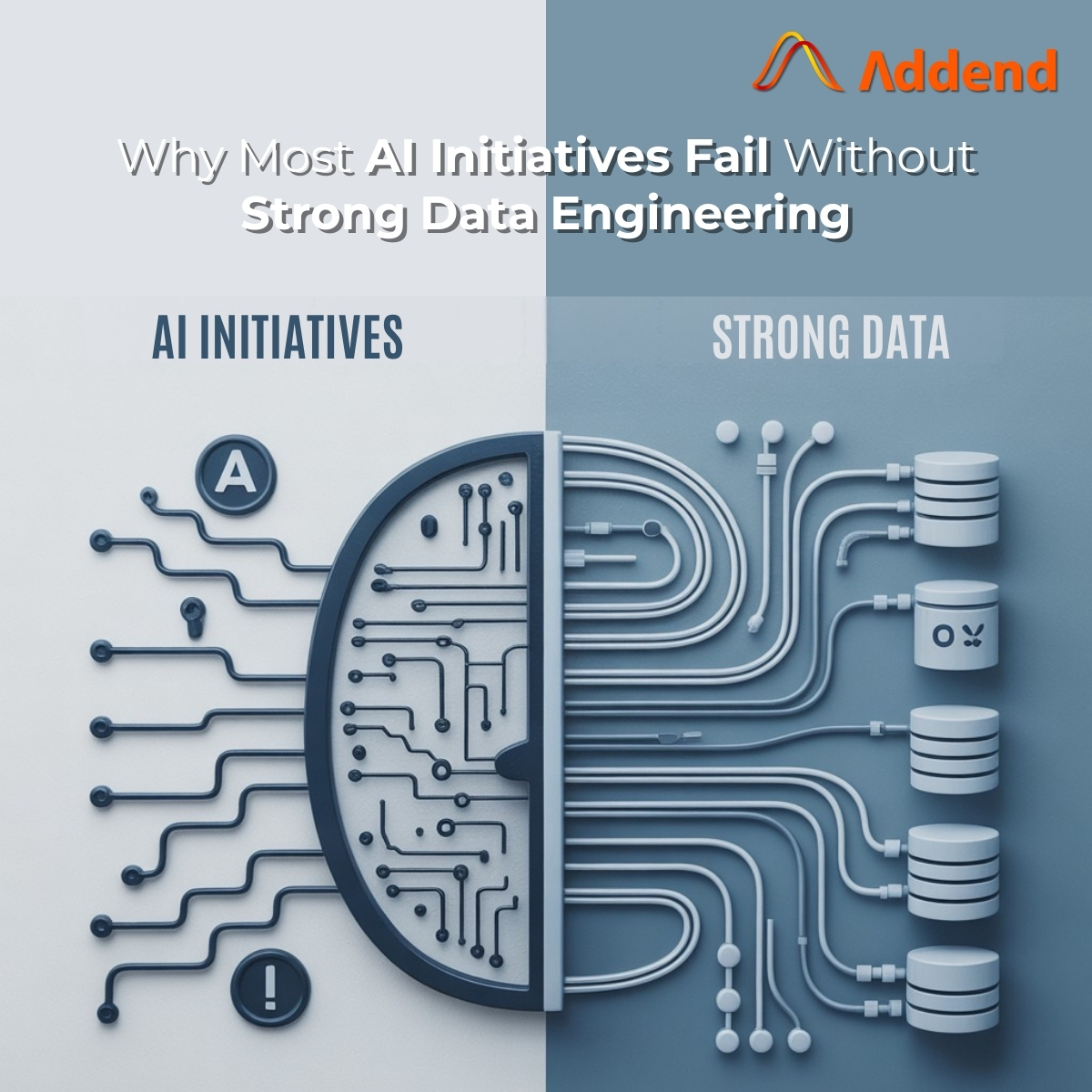
AI has quickly moved from experimentation to expectation.
Across industries, leadership teams are no longer debating whether they should invest in AI. Instead, they are asking a more uncomfortable question: why, after months of effort and significant investment, does meaningful business impact remain elusive? Forecasting improvements stall. Automation initiatives pause. Decision-making feels no faster or more confident than before.
This widening gap between AI ambition and business reality is now visible at the executive level.
Industry research consistently shows that most AI initiatives fail to deliver sustained value once they move beyond pilots. The reason is rarely a lack of advanced models or technical talent. More often, it is the data environment supporting those initiatives – fragmented pipelines, inconsistent definitions, and weak governance – that was never designed for intelligence at scale.
Most organizations still operate analytics foundations built for reporting. Those foundations can support dashboards. They cannot reliably support AI systems expected to learn, adapt, and influence decisions continuously.
As AI becomes embedded deeper into core business processes, this mismatch creates real operational and reputational risk. Outputs that cannot be traced, explained, or validated are difficult for leaders to act on, regardless of how sophisticated the model may be.
The reality is straightforward but often overlooked: AI success is determined long before the first model is trained. It is determined by the strength of the data engineering and governance layers beneath it.
Why AI Fails in the Enterprise – And Why It’s Rarely About the Model
AI has not failed because organizations lack ambition.
On the contrary, many enterprises have invested heavily in data science teams, cloud infrastructure, and advanced machine learning platforms. Yet research from Gartner shows that close to 85% of AI initiatives fail to deliver expected business value. The dominant reasons cited are poor data quality, weak integration, and insufficient governance.
This matters because it reframes the problem.
AI initiatives do not collapse at the modeling stage. They collapse when outputs reach decision-makers who cannot reconcile them with trusted numbers, operational context, or financial reality. At that point, confidence erodes quickly, and initiatives stall – often quietly.
In practice, AI does not fail loudly.
It fails through hesitation.
Through delayed adoption.
Through outputs that are technically correct but operationally unusable.
What AI Actually Needs to Work at Scale
Despite the complexity of AI systems, the conditions they require to succeed are surprisingly consistent.
AI depends on reliable data that is accurate, timely, and complete. It requires consistent structure – shared definitions, governed relationships, and stable semantics. And it needs operational pipelines that keep data current and connected to real business processes.
When these conditions are missing, AI models still generate outputs – but those outputs are often misleading, delayed, or impossible to act on.
Research published by MIT Sloan reinforces this point, showing that data readiness is a stronger predictor of AI success than model sophistication. Organizations with disciplined data foundations consistently outperform peers that focus primarily on algorithms.
This is also why large language models struggle in enterprise environments. When trained or grounded on inconsistent, poorly governed data, they may sound confident but lack reliability, traceability, and decision context.
Why Traditional Analytics Architectures Break Under AI Pressure
Most enterprise analytics stacks were never designed with AI in mind.
They evolved to support reporting and visualization, not prediction or automation. Common patterns include siloed data sources feeding isolated dashboards, manual data preparation by analysts, inconsistent KPIs across departments, and limited visibility into lineage or ownership.
These approaches were workable when analytics was primarily backward-looking.
They break down when analytics is expected to recommend actions, forecast outcomes, or automate decisions.
AI demands a fundamentally different architecture – one where strong data engineering is not a backend concern, but a strategic capability.
Talk to a Microsoft Fabric & AI Expert
Get clarity on whether your current analytics environment is built for reporting – or for intelligence.
The Strategic Role of Data Engineering in AI Readiness
Data engineering sits at the center of every successful AI initiative, whether it is acknowledged or not.
When designed well, data engineering creates a single, trusted data foundation, automated pipelines that reduce manual effort, governed datasets suitable for machine learning, and timely access to insights across the organization.
When designed poorly, it becomes the silent reason AI initiatives fail.
There is also a clear financial dimension. Analysis from McKinsey shows that organizations with weak data foundations spend 30–40% more on AI initiatives due to duplicated pipelines, rework, and failed deployments. These costs rarely appear directly in AI budgets, but they accumulate over time and undermine ROI.
Successful organizations follow a clear progression:
Data Engineering → Governed Analytics → AI Models → Decision Automation
Each layer depends entirely on the integrity of the one beneath it. Unstable pipelines lead to model drift. Inconsistent definitions produce conflicting predictions. Weak governance erodes trust in outputs.
Strong data engineering is not about speed alone. It is about making data usable, explainable, and operational at scale.
Building AI-Ready Platforms with Microsoft-Native Architecture
Organizations that scale AI successfully tend to converge on unified, Microsoft-native architectures designed for intelligence rather than reporting alone.
Microsoft Fabric and OneLake
Microsoft Fabric introduces OneLake as a single, governed data foundation. Instead of managing separate ETL tools, multiple warehouses, and duplicated datasets for analytics and modeling, teams work from a shared platform.
This consolidation reduces cost, simplifies architecture, and improves consistency across analytics and AI workloads.
Direct Lake and Governed Semantic Models
Direct Lake allows analytics and AI workloads to access data directly from OneLake, eliminating repeated ingestion and refresh cycles. This results in faster insights, simpler pipelines, and consistent data across dashboards, machine learning models, and Copilot experiences.
Governed semantic models ensure that both business users and AI systems interpret data the same way – an essential requirement for trust and adoption.
Azure AI and Copilot Integration
When AI is embedded inside the data platform, it becomes operational.
Integration with Azure AI and Microsoft Copilot enables organizations to train models on governed datasets, embed predictions into workflows, query enterprise data using natural language, and automate actions based on insights.
None of this works reliably without disciplined data engineering underneath.
The C-Suite Lens: Cost, Risk, and Time-to-Value
Weak data engineering makes AI expensive. Models require frequent rework, engineering teams spend time fixing pipelines instead of delivering value, and cloud costs rise due to duplicated processing and storage. Strong data engineering lowers the total cost of ownership by consolidating tools and enabling shared infrastructure.
Risk is equally important. For CFOs and COOs, unreliable AI outputs are worse than no AI at all. Conflicting forecasts and unexplained recommendations undermine confidence in analytics. Governance, lineage, and data quality controls make AI outputs defensible and auditable.
Time-to-value often determines whether AI initiatives survive. Organizations that prioritize data engineering first bring AI pilots into production faster, achieve adoption sooner, and see ROI earlier. The fastest AI programs are data-first, not model-first.
Why AI Initiatives Commonly Stall
Across enterprise postmortems and analyst research, the same pitfalls appear repeatedly: treating AI as a bolt-on capability, underestimating data preparation effort, assuming dashboards equal readiness, delaying governance, and over-customizing before standardizing.
The most damaging misconception is believing that better visualization will solve data problems.
Dashboards reveal issues.
AI amplifies them.
Microsoft’s own guidance consistently reinforces this reality: AI maturity directly correlates with data platform maturity.
How Addend Analytics Addresses the Root Cause
Addend Analytics approaches AI by starting where most initiatives should have begun – with the data foundation.
We design Microsoft-native, data-first platforms using Fabric, Azure AI, Power BI, and governed analytics architectures that scale. Our focus is not tool deployment, but outcomes: reliable pipelines, trusted analytics layers, operational AI models, and decision automation leaders can rely on.
Every engagement begins with clarity. Which decisions require intelligence? What data supports those decisions? What architecture minimizes cost and risk?
Rather than committing to large programs upfront, we de-risk AI through focused proofs of concept, accelerators, and incremental platform builds that demonstrate value early and scale responsibly.
Start with a Risk-Free Analytics or AI POC
Validate AI value quickly – before scaling investment or exposure.
AI Success Starts Before the Model
AI is not failing because organizations lack ambition or access to technology.
It fails because foundations are ignored in the rush to innovate.
Strong data engineering is not optional. It is the prerequisite for trustworthy AI, scalable analytics, and automated decision-making.
The organizations that succeed with AI over the next five years will not be those with the most advanced models – but those with the most disciplined data foundations.
Fix the root cause, not the symptom.
That is where AI becomes real.
Move from AI experimentation to AI execution.
Assess whether your data engineering and analytics foundation is actually ready to support AI at scale, and identify what needs to change before risk and cost increase.
Author By

Kamal Sharma
Kamal brings over 20 years of experience in data analytics and business intelligence. He has led the design and implementation of analytics solutions across operations, financial reporting, and performance improvement initiatives. With a background in business statistics and Six Sigma, his work focuses on applying data in a structured and practical way to solve real business challenges.