
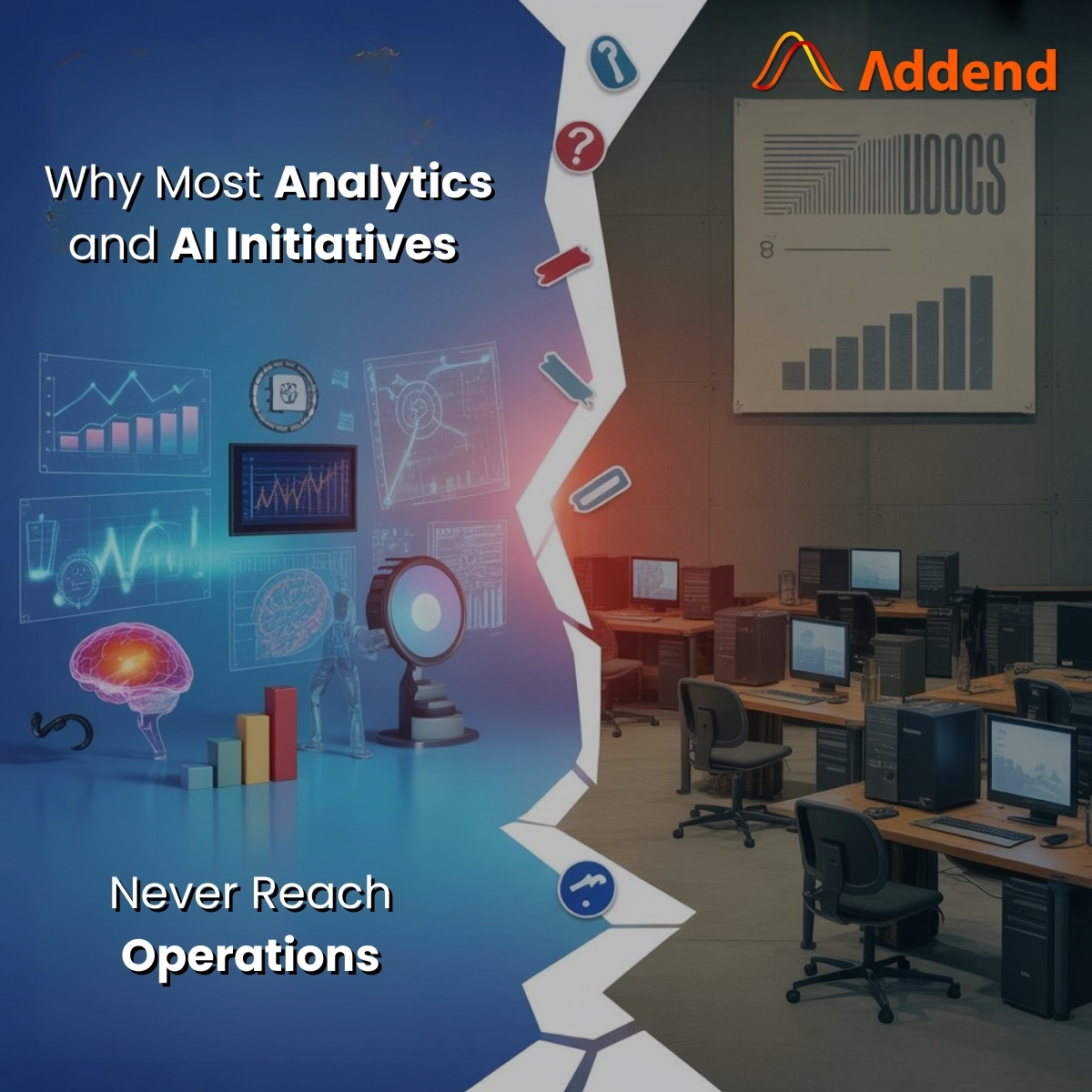
For more than a decade, organizations have invested heavily in analytics platforms, data engineering, and now artificial intelligence. The promise has always been the same: better decisions, faster execution, and a more intelligent enterprise.
And yet, if you look closely at how most organizations actually operate, very little has changed.
Dashboards are reviewed. Forecasts are presented. AI pilots are discussed.
But when it’s time to act, to approve spending, adjust pricing, change production plans, or take risk decisions still depend on judgment calls, manual validation, and side conversations that sit outside the analytics environment.
This gap between analytics effort and operational impact is not new. What is new is how visible and costly it has become.
According to long-running research from Gartner, a majority of analytics and AI initiatives fail to deliver sustained business value. The reasons cited are remarkably consistent year after year: lack of trust in data, weak governance, fragmented architectures, and poor integration into business processes.
None of those are model problems.
None of those are tool problems.
They are operational problems and increasingly, leadership problems.
Download From Dashboards to Decisions: A Practical Guide to Operational Analytics & AI
Understand why analytics and AI stall before they reach operations, and what leaders do differently.
The Mistake Leaders Keep Making About Analytics and AI
Most executives evaluate analytics and AI initiatives the wrong way.
They ask:
- Do we have dashboards?
- Are we using modern platforms?
- Have we launched AI use cases?
- Are teams “adopting” the tools?
These questions measure activity, not impact.
The better question – the one almost no one asks early enough – is this:
Does analytics reliably influence the decisions that actually run the business?
If the answer is no, then analytics and AI have not reached operations. They may be sophisticated. They may be technically impressive. But they are not doing the job that leaders believe they are paying for.
This misunderstanding explains why so many organizations feel stuck despite constant investment. They keep modernizing the surface of analytics while leaving the operating model underneath unchanged.
Why Analytics Stops at the Report – Even in Advanced Organizations
Most analytics environments were never designed to run the business. They were designed to explain it.
Business intelligence grew up around reporting cycles: monthly reviews, quarterly performance updates, and executive summaries. The architecture, governance, and incentives all evolved around that use case.
AI has now been layered on top of this reporting-centric foundation, and that is where things begin to break.
AI systems assume that:
- Definitions are stable
- Data is consistent across time and teams
- Logic is reusable and governed
- Outputs can be trusted without manual reconciliation
In reality, many organizations still operate with analytics environments where:
- Finance and operations define the same metric differently
- Business logic lives inside reports instead of shared models
- Data pipelines are rebuilt for each use case
- Governance is enforced socially, not technically
AI does not fix these issues. It exposes them.
Research published by MIT Sloan has shown that data readiness and governance maturity are stronger predictors of AI success than algorithm choice or model sophistication. This finding is deeply inconvenient because it means AI success depends less on innovation and more on discipline.
Request a Free AI & Analytics Readiness Assessment
Get an objective view of whether your analytics foundation is ready to support operational AI before scaling further.
The Real Reason AI Pilots Rarely Scale
AI pilots often work.
They fail later, when they encounter the real organization.
In pilots, data is curated. Definitions are clarified. Exceptions are ignored. Models are evaluated in isolation. In production, none of that holds.
Pipelines break when upstream systems change.
Predictions conflict with financial reports.
Governance questions surface only after decisions are challenged.
At that point, confidence erodes quietly. The AI system isn’t rejected outright; it’s simply bypassed.
This is why McKinsey has repeatedly reported that organizations with weak data foundations incur 30–40% higher costs in advanced analytics and AI initiatives. The money is not lost in one place. It leaks slowly through rework, duplication, and stalled deployments.
AI does not fail dramatically.
It fails by never becoming operational.
Operational Analytics Is Not a Tool Category – It’s a Design Choice
What separates organizations where analytics runs the business from those where it merely describes it is not the choice of tools. It is the choice of design intent.
Operational analytics starts with a different premise:
- Analytics exists to support decisions, not reports
- Consistency matters more than flexibility
- Governance is an enabler, not a constraint
- Reuse is more valuable than customization
This is where Microsoft-native architectures, particularly Microsoft Fabric, have changed what is possible. By unifying data engineering, analytics, and AI on a single foundation (OneLake), organizations can finally align data flow, governance, and decision logic.
But even the best platforms cannot compensate for unclear intent.
Technology can support operational analytics.
It cannot decide to operationalize it.
Talk to a Microsoft Fabric & Operational Analytics Expert
Understand how Microsoft-native architecture enables analytics and AI to operate at decision speed.
The Leadership Shift That Has to Happen
The organizations that succeed with analytics and AI make a subtle but powerful shift.
They stop asking:
How advanced is our analytics stack?
And start asking:
Where do decisions still bypass analytics and why?
That question changes everything.
It exposes where trust is missing.
Where definitions are unstable.
Where governance is absent.
Where analytics is treated as advisory rather than authoritative.
Answering it requires uncomfortable conversations across business, finance, IT, and data teams. But without that clarity, analytics modernization and AI investment become performative.
Where Addend Analytics’ Perspective Fits
Addend Analytics exists in the gap between analytics capability and operational reality.
The focus is not on deploying tools or launching isolated AI use cases, but on helping organizations make analytics and AI decision-ready, governed, explainable, and embedded into how the business actually runs.
That means starting with decisions, not dashboards.
Architecture, not aesthetics.
Discipline before scale.
This approach is deliberately less flashy. It is also the reason analytics and AI initiatives reach production instead of stalling in perpetual pilots.
Start with a Risk-Free Analytics or AI Proof of Concept
Validate operational impact before committing to large-scale investment.
FAQs: Analytics, AI, and Operational Decision-Making
Why do most analytics and AI initiatives fail to reach operations?
Most analytics and AI initiatives fail to reach operations because they are built for reporting and experimentation, not for decision execution. Weak data engineering, inconsistent definitions, and a lack of governance prevent analytics and AI outputs from being trusted or embedded into day-to-day business workflows.
What does it mean for analytics and AI to be operational?
Analytics and AI are operational when they directly influence real business decisions, not just reports or presentations. This means insights are trusted, timely, governed, and embedded into workflows where actions are taken, rather than reviewed after the fact.
Why do AI pilots work but fail in production?
AI pilots often succeed in controlled environments with curated data and simplified assumptions. They fail in production when they encounter real-world data complexity, changing source systems, inconsistent business definitions, and governance requirements that were not addressed during the pilot phase.
Are dashboards enough to be considered data-driven?
No. Dashboards provide visibility, not decision readiness. Being data-driven requires consistent definitions, trusted data pipelines, and analytics that reduce decision friction rather than create debate. Dashboards alone do not ensure analytics or AI can be operationalized.
How does data governance impact AI success?
Data governance ensures consistency, traceability, and trust in analytics and AI outputs. Without governance, AI models produce results that are difficult to explain, validate, or defend, which prevents adoption at the leadership and operational level.
What role does Microsoft Fabric play in operational analytics and AI?
Microsoft Fabric provides a unified, Microsoft-native platform where data engineering, analytics, and AI share a single governed foundation through OneLake. This architecture reduces duplication, improves consistency, and enables analytics and AI to scale reliably into operations.
How can organizations assess if their analytics is ready for AI?
Organizations can assess AI readiness by evaluating whether their analytics is trusted across teams, governed consistently, reusable across use cases, and embedded into decision workflows. If analytics still requires manual reconciliation or explanation, AI readiness is premature.
What is the first step to making analytics and AI operational?
The first step is not selecting tools or launching AI use cases, but identifying which business decisions matter most and whether current analytics and data foundations can reliably support those decisions at scale.
Analytics and AI are no longer differentiators.
Operational analytics is.
The next competitive advantage will not come from who has the most data, the most dashboards, or the most models. It will come from those who can act with confidence when decisions matter, without stopping to question the numbers.
If analytics does not change how decisions are made, it is unfinished work.
And finishing that work is no longer a technical upgrade.
It is a leadership choice.
Download From Dashboards to Decisions and Book a 30-Minute Assessment
Move from analytics that inform to analytics that actually run the business.
Author By

Gaurav Lakhotia
Gaurav holds an MBA in Business Analytics. As a data geek and avid learner, he has earned accolades including Microsoft Certified Data Analyst, Microsoft Certified Azure Administrator, and active Power BI Community contributor. He is also a Microsoft Certified Trainer. With critical thinking and project delivery skills, he strives to achieve customer delight in Data Analytics projects. Gaurav loves travelling with friends when he is not busy working on data.